
How it works
Each pending call occupies a stack frame, so recursion depth costs memory even when the code looks small.
State the recursion depth for a given input to reason about space, not only time.
Common error
Assuming recursion is free. Depth proportional to input size means linear extra space.
Worked example
Java snippets run inside a main method. Add import java.util.*; when collection types are used.
Java
class Solver {
    void visit(int n) {
        if (n == 0) return;
        System.out.print(n + " ");
        visit(n - 1);
        System.out.print(n + " ");
    }
}
new Solver().visit(2);
Output
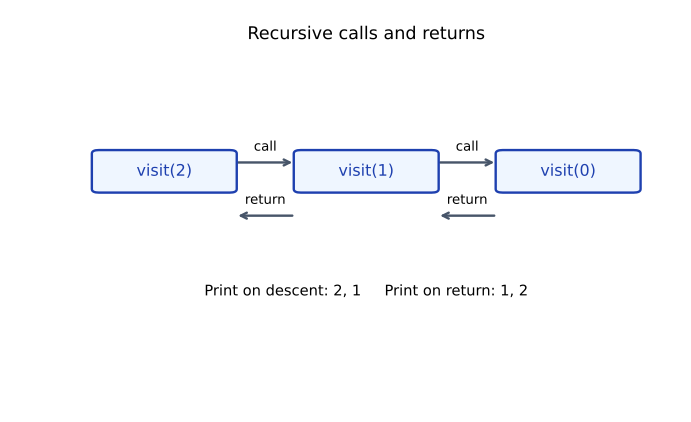
2 1 1 2 Each call retains its local n while a deeper call runs. Statements before the recursive call execute on descent; statements after it execute while calls return.
Exercises
1.2.1 · Explain
For visit(3) in the example, give the printed sequence.
Show solution
The sequence is 3 2 1 1 2 3. Each call prints before descending and again after its child returns.
1.2.2 · Write code
Write a recursive method that prints 1 through 3 in increasing order by making the recursive call before printing.
Show solution
The deeper call completes the smaller prefix first.
One valid solution
class Solver {
    void up(int n) {
        if (n == 0) return;
        up(n - 1);
        System.out.print(n + " ");
    }
}
new Solver().up(3);
Expected output
1 2 3