
How it works
A linked list is nodes each holding a value and a reference onward. There is no index, so position k costs k steps to reach.
Walk from the head, counting steps, and keep a reference to the previous node when you may need to modify.
Common error
Assuming constant-time access. That is an array property and does not survive the switch.
Worked example
Java snippets run inside a main method. Add import java.util.*; when collection types are used.
Java
class Node {
    int value; Node next;
    Node(int value, Node next) { this.value = value; this.next = next; }
}
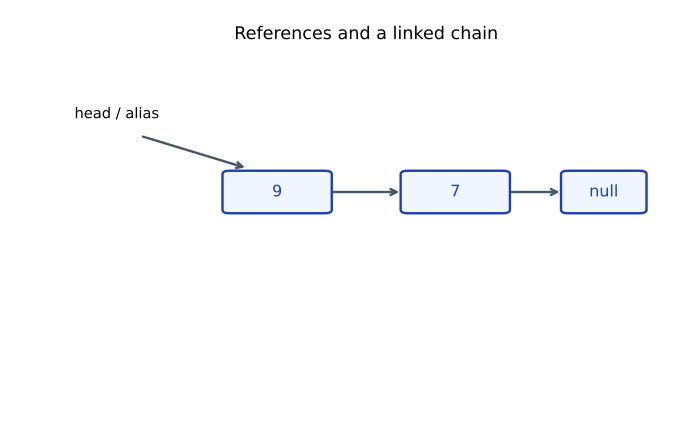
Node head = new Node(4, new Node(7, null));
Node alias = head;
alias.value = 9;
System.out.println(head.value + ":" + head.next.value);
Output
9:7Each node stores a value and a reference to its successor. Assigning head to alias copies the reference, so both names initially identify the same mutable node.
Exercises
3.1.1 · Explain
After alias = head.next, does assigning alias = null remove the second node from the list?
Show solution
No. It only changes the local alias variable. The link stored in head.next still refers to that node.
3.1.2 · Explain
What condition ends a straightforward singly linked traversal?
Show solution
The current reference becomes null after the last node, assuming the list has no cycle. A cycle requires different termination logic.