
How it works
Chaining hangs a secondary structure off each bucket; open addressing probes for another slot. Linear probing suffers primary clustering, where occupied runs lengthen future probes.
Compare the two by memory behavior and by how gracefully they degrade as the table fills.
Common error
Treating a collision as an error. Collisions are expected and handled, not prevented.
Worked example
Example
Capacity: 5
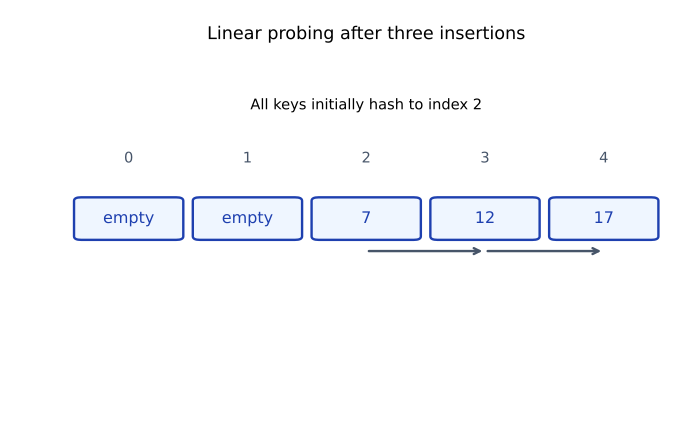
Keys inserted: 7, 12, 17
Bucket index: key mod 5
All three initially map to bucket 2
Chaining stores multiple entries at a bucket, while open addressing searches other table positions. A probing scheme must define lookup and deletion consistently so a removed entry does not hide later displaced keys.
Exercises
5.3.1 · Explain
Under linear probing in an empty capacity-5 table, where do 7, 12, and 17 land?
Show solution
They initially hash to 2. With linear probing, they occupy indices 2, 3, and 4 in that insertion order.
5.3.2 · Write code
Insert 7, 12, and 17 into an empty capacity-5 table using linear probing. Use null to mark an unused slot and print the table.
Show solution
All three hash to 2; wrap around with remainder if a later position is needed.
One valid solution
Integer[] table = new Integer[5];
for (int key : new int[]{7,12,17}) {
    int index = Math.floorMod(key, table.length);
    while (table[index] != null) index = (index + 1) % table.length;
    table[index] = key;
}
System.out.println(Arrays.toString(table));
Expected output
[null, null, 7, 12, 17]