
How it works
In-order visits left, node, right and yields sorted order on a binary search tree. Pre-order suits copying, post-order suits deletion, and level-order needs a queue.
Choose the traversal by what the task requires rather than by habit.
Common error
Deleting a tree pre-order, which frees a parent while its children are still reachable only through it.
Worked example
Example
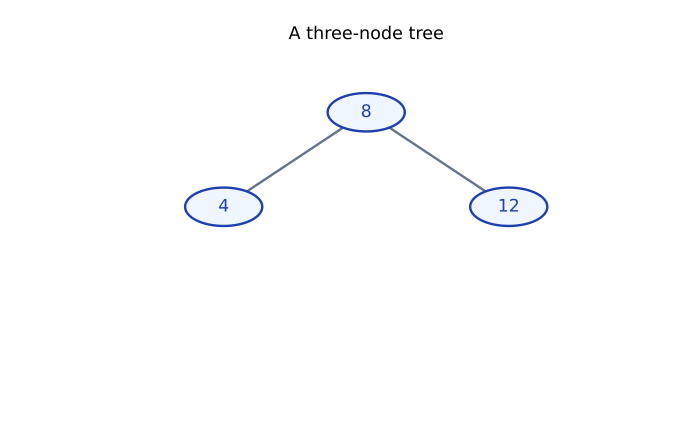
Tree: root 8; left 4; right 12
Preorder: node, left, right
Inorder: left, node, right
Postorder: left, right, node
The same tree produces different visit orders depending on when the node is processed. Inorder traversal of a binary search tree yields sorted keys when the tree obeys the chosen ordering and duplicate policy.
Exercises
6.2.1 · Explain
Give preorder, inorder, and postorder for root 8 with left child 4 and right child 12.
Show solution
Preorder: 8, 4, 12. Inorder: 4, 8, 12. Postorder: 4, 12, 8.
6.2.2 · Write code
Implement inorder traversal for a tree rooted at 8 with children 4 and 12. Print its keys.
Show solution
Recursively process the left subtree, then the current node, then the right subtree.
One valid solution
class Node {
    int key; Node left, right;
    Node(int key) { this.key = key; }
}
class Walker {
    void inorder(Node node) {
        if (node == null) return;
        inorder(node.left);
        System.out.print(node.key + " ");
        inorder(node.right);
    }
}
Node root = new Node(8);
root.left = new Node(4); root.right = new Node(12);
new Walker().inorder(root);
Expected output
4 8 12