
Geometry Honors · Lesson 7.2
Cross Sections and Scale
How it works
A cross section is the intersection of a solid with a plane. Its shape depends on the direction of the cut. For similar solids, lengths, surface areas, and volumes scale by the first, second, and third powers of the same factor.
Worked examples
Example 1
Similar solids have length factor . Give the surface-area and volume factors.
Surface area scales by and volume by .
Example 2
A plane parallel to a cylinder base cuts the cylinder. What is the section?
It is a circular disk congruent to the base, provided the cut meets the cylinder between its bases.
Problems
Problem 7.2.1
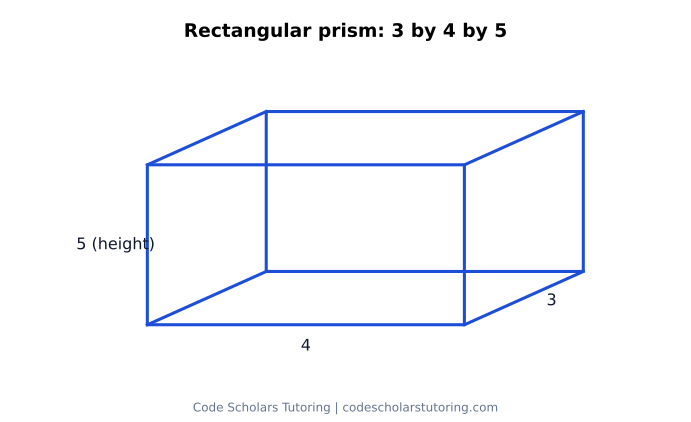
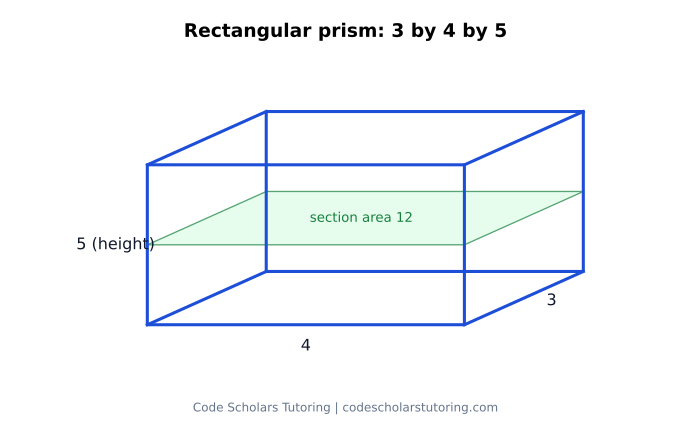
A by by rectangular prism is cut parallel to its by base halfway up. Give the cross-section area.
Show worked solution
The section is a by rectangle, so its area is square units.
Problem 7.2.2
Similar solids have volume ratio . Find the length ratio.
Show worked solution
Take cube roots to get .
Problem 7.2.3
A sphere of radius is cut by a plane units from its center. Find the cross-section radius.
Show worked solution
A right triangle gives .