
How it works
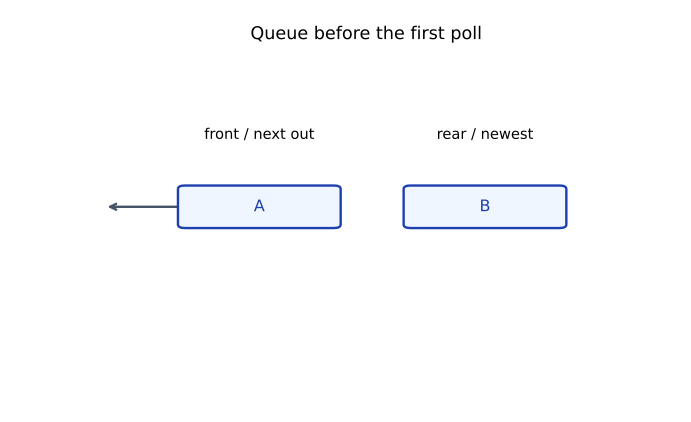
A queue adds at the rear and removes from the front, so items leave in arrival order. That fits scheduling and level-by-level exploration.
Reach for a queue whenever fairness or breadth-first order matters.
Common error
Confusing the two disciplines under pressure; the traversal you get depends entirely on which you chose.
Worked example
Java snippets run inside a main method. Add import java.util.*; when collection types are used.
Java
Queue<String> queue = new ArrayDeque<String>();
queue.offer("A"); queue.offer("B");
System.out.println(queue.poll());
System.out.println(queue.peek());
Output
A
B
A queue removes the earliest waiting item first. This order fits ordinary service lines and breadth-first graph exploration when all traversed edges have equal cost.
Exercises
4.2.1 · Explain
Starting empty, enqueue 4, enqueue 9, dequeue, enqueue 2. Give the remaining dequeue order.
Show solution
The first dequeue removes 4. The remaining order is 9, then 2.
4.2.2 · Write code
Use a queue to print 3, 1, 4 in their insertion order.
Show solution
Append at the rear and remove from the front.
One valid solution
Queue<Integer> q = new ArrayDeque<Integer>();
q.offer(3); q.offer(1); q.offer(4);
while (!q.isEmpty()) System.out.print(q.poll() + " ");
Expected output
3 1 4