
How it works
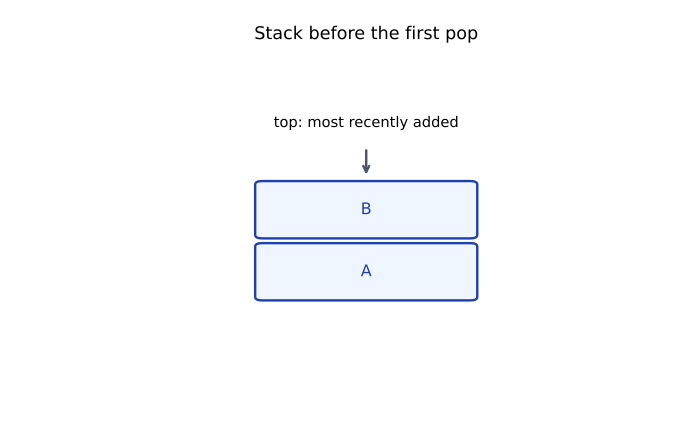
A stack pushes and pops at one end, so the most recent item leaves first. That ordering is what makes it match nesting, backtracking, and call stacks.
Reach for a stack whenever the problem involves matching pairs or undoing recent work.
Common error
Treating a stack as a general list and indexing into it, which discards the guarantee that makes it useful.
Worked example
Java snippets run inside a main method. Add import java.util.*; when collection types are used.
Java
Deque<String> stack = new ArrayDeque<String>();
stack.push("A"); stack.push("B");
System.out.println(stack.pop());
System.out.println(stack.peek());
Output
B
A
A stack exposes the most recently added item first. Matching opening and closing delimiters, undo histories, and call-stack models all depend on this last-in-first-out order.
Exercises
4.1.1 · Explain
Starting empty, push 2, push 5, pop, push 7. What values are removed by two more pops?
Show solution
The first pop removes 5. After pushing 7, the next pops remove 7 and then 2.
4.1.2 · Write code
Reverse the values 1, 2, 3 using an ArrayDeque as a stack.
Show solution
Push each value, then pop until empty.
One valid solution
Deque<Integer> s = new ArrayDeque<Integer>();
for (int v : new int[]{1,2,3}) s.push(v);
while (!s.isEmpty()) System.out.print(s.pop() + " ");
Expected output
3 2 1