
How it works
BFS uses a queue and expands in layers, so the first time it reaches a vertex it has used the fewest edges. That is why it solves unweighted shortest paths.
Use BFS when the fewest steps matters and edges carry no weight.
Common error
Expecting BFS to handle weighted shortest paths. Layer order is not weight order.
Worked example
Example
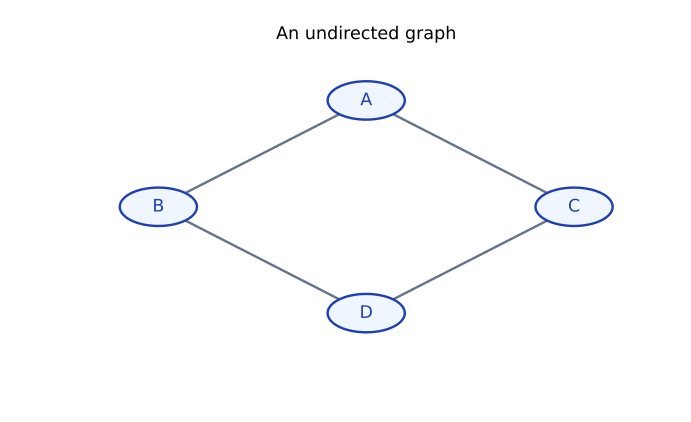
Graph: A-B, A-C, B-D, C-D
Start A; neighbors processed alphabetically
Queue initially: A
Mark each vertex when enqueued
Breadth-first search visits vertices by increasing edge distance from the start in an unweighted graph. Marking at enqueue time prevents the same discovered vertex from being queued repeatedly.
Exercises
8.2.1 · Explain
Give BFS order and the edge distance from A to D for the displayed graph.
Show solution
The order is A, B, C, D under alphabetical neighbor processing. D has distance 2 from A.
8.2.2 · Write code
Implement BFS from A for the displayed graph, processing each adjacency list alphabetically. Mark vertices when enqueued.
Show solution
A queue preserves distance layers and a visited set prevents duplicate enqueues.
One valid solution
Map<String,List<String>> graph = Map.of(
    "A", List.of("B","C"), "B", List.of("A","D"),
    "C", List.of("A","D"), "D", List.of("B","C"));
Queue<String> queue = new ArrayDeque<String>();
Set<String> seen = new HashSet<String>();
queue.offer("A"); seen.add("A");
while (!queue.isEmpty()) {
    String node = queue.remove();
    System.out.print(node + " ");
    for (String next : graph.get(node))
        if (seen.add(next)) queue.offer(next);
}
Expected output
A B C D