
How it works
DFS uses a stack, explicitly or through recursion, and goes deep before backtracking. It underpins cycle detection and topological ordering.
Detect a cycle in a directed graph by finding an edge back to a vertex still on the recursion stack.
Common error
Calling any edge to a visited vertex a cycle. An edge to a finished vertex is legal in an acyclic graph.
Worked example
Java snippets run inside a main method. Add import java.util.*; when collection types are used.
Java
Map<String,List<String>> graph = Map.of(
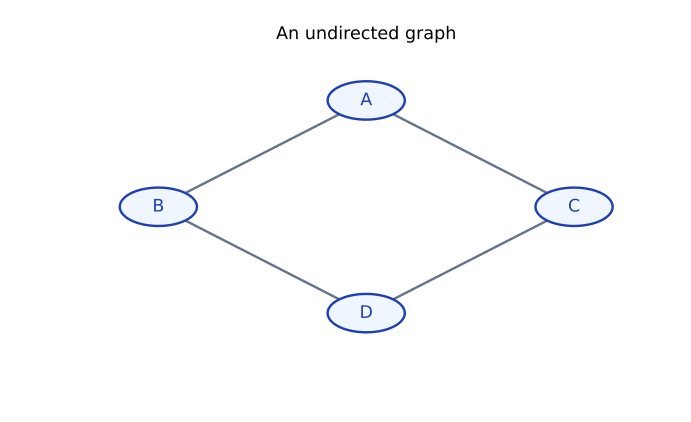
    "A", List.of("B","C"), "B", List.of("A","D"),
    "C", List.of("A","D"), "D", List.of("B","C"));
class Walker {
    Set<String> seen = new HashSet<String>();
    void visit(String node) {
        if (!seen.add(node)) return;
        System.out.print(node + " ");
        for (String next : graph.get(node)) visit(next);
    }
}
new Walker().visit("A");
Output
A B D C Depth-first search follows one branch before returning to remaining alternatives. The visited set prevents repeated exploration around a cycle. Exact visit order depends on the neighbor order and implementation.
Exercises
8.3.1 · Explain
Give recursive DFS visit order from A using alphabetical neighbor order.
Show solution
A, B, D, C. From D, C is the next unvisited neighbor before recursion returns to A.
8.3.2 · Explain
Does DFS necessarily find the minimum-edge path to a target?
Show solution
No. It explores depth rather than distance layers. BFS is the standard choice for shortest edge-count paths in an unweighted graph.