AP Precalculus · Lesson 1.6
End Behavior of Rational Functions
How it works
Compare numerator and denominator degrees to determine rational end behavior. A smaller numerator degree gives horizontal asymptote y = 0. Equal degrees give the ratio of leading coefficients. A numerator degree exactly one larger can give a slant asymptote found by division.
Worked examples
Example 1
Find the horizontal asymptote of .
The degrees are equal, so the asymptote is the leading-coefficient ratio: .
Example 2
Find the slant asymptote of .
Division gives . The last term approaches zero, so the slant asymptote is .
Problems
Problem 1.6.1
Find the horizontal asymptote of .
Show worked solution
The numerator degree is smaller, so the horizontal asymptote is .
Problem 1.6.2
Find the horizontal asymptote of .
Show worked solution
Equal degrees give .
Problem 1.6.3
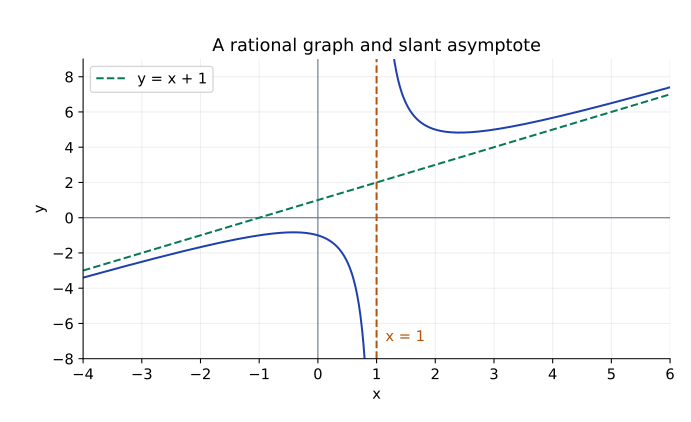
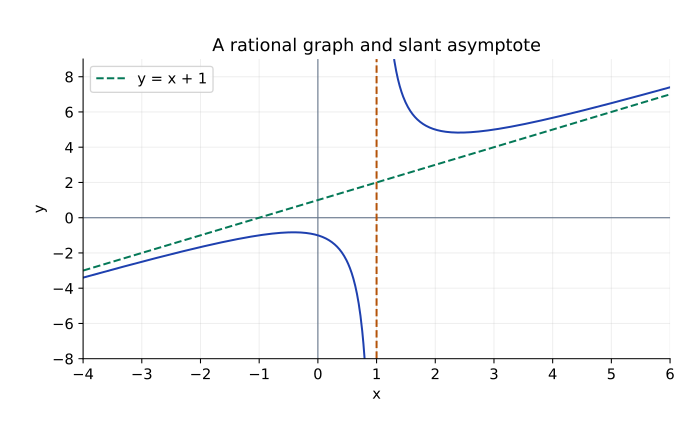
Use the graph of to identify its slant and vertical asymptotes.
Show worked solution
Division gives . The slant asymptote is ; the vertical asymptote is .