Algebra 1 Honors · Lesson 3.2

Forms of a Linear Equation

How it works

Slope-intercept form displays slope and vertical intercept directly. Point-slope form is useful when a point and slope are known. Standard form can reveal intercepts by setting one variable to zero. Converting between forms changes the representation, not the line.

y=mx+b,y−y1=m(x−x1)y=mx+b,\qquad y-y_1=m(x-x_1)

Worked examples

Example 1

Write the line with slope 3\displaystyle 3 through (2,1)\displaystyle (2,1).

Point-slope form gives y−1=3(x−2)\displaystyle y-1=3(x-2). Simplifying gives y=3x−5\displaystyle y=3x-5.

Example 2

Find the intercepts of 2x+3y=12\displaystyle 2x+3y=12.

For y=0\displaystyle y=0, x=6\displaystyle x=6. For x=0\displaystyle x=0, y=4\displaystyle y=4. The intercepts are (6,0)\displaystyle (6,0) and (0,4)\displaystyle (0,4).

Problems

Problem 3.2.1

Write a slope-intercept equation for slope −2\displaystyle -2 and y-intercept 5\displaystyle 5.

Show worked solution

Substitute the slope and intercept into y=mx+b\displaystyle y=mx+b: y=−2x+5\displaystyle y=-2x+5.

Problem 3.2.2

Write an equation through (1,4)\displaystyle (1,4) with slope 2\displaystyle 2.

Show worked solution

y−4=2(x−1)\displaystyle y-4=2(x-1), so y=2x+2\displaystyle y=2x+2.

Problem 3.2.3

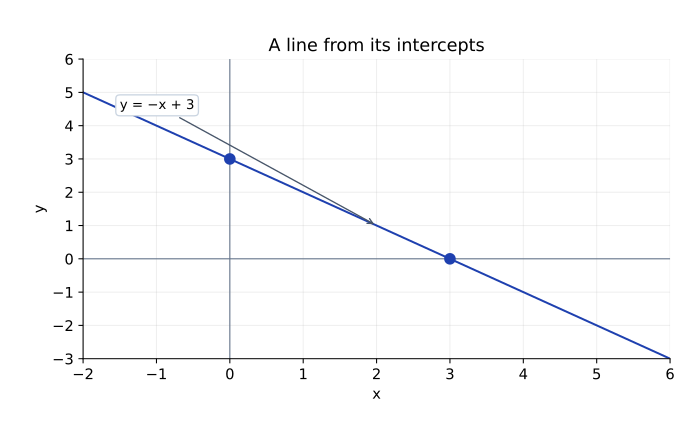
Write an equation for the graphed line using its intercepts.
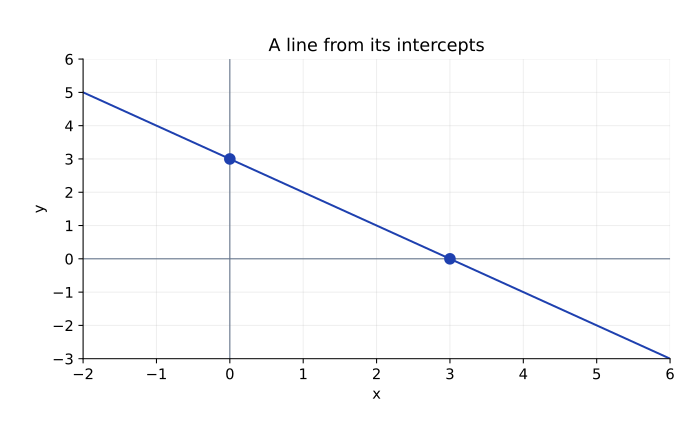
A line meets the vertical axis at 3 and the horizontal axis at 3.
Use the two intercepts to describe the line.
Show worked solution

The intercepts are (0,3)\displaystyle (0,3) and (3,0)\displaystyle (3,0). Its slope is −1\displaystyle -1, so y=−x+3\displaystyle y=-x+3.

A line meets the vertical axis at 3 and the horizontal axis at 3. The equation is y = −x + 3.
The equation is y = −x + 3.

Need help with this topic?

Work through questions with a tutor and get help with the steps you find difficult.

Get help with this topic