Algebra 1 Honors · Lesson 3.1
Slope as a Rate
How it works
Slope measures change in output per unit change in input. Use the same point order in numerator and denominator. Positive slope indicates increasing output; a horizontal line has slope zero. A vertical line has undefined slope because its change in x is zero.
Worked examples
Example 1
Find the slope through and .
. Output increases by for each added input unit.
Example 2
A tank drops from liters to liters in minutes. Find the average rate.
The rate is liters per minute. The negative sign represents decreasing volume.
Problems
Problem 3.1.1
Find the slope through and .
Show worked solution
.
Problem 3.1.2
Find the slope of the line through and .
Show worked solution
The denominator is , so the line is vertical and its slope is undefined.
Problem 3.1.3
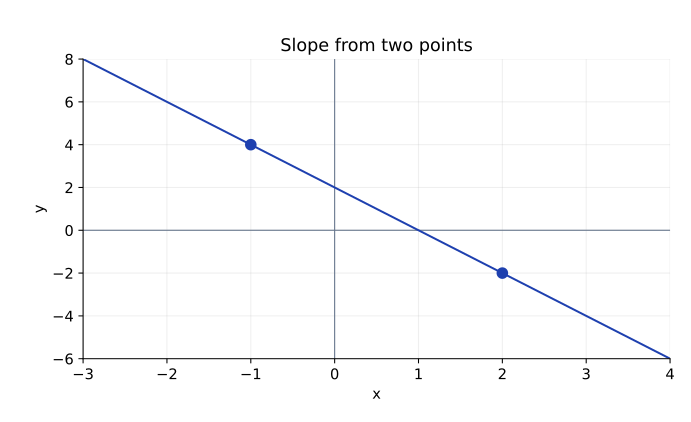
Use the graphed points to find the slope and explain its sign.
Show worked solution
The points are and . The slope is ; the line falls as increases.