
Algebra 1 Honors · Lesson 6.3

The Discriminant

How it works

The discriminant is the expression under the square root in the quadratic formula. Its sign determines the number of real roots. A positive nonsquare value gives two irrational real roots; zero gives one repeated real root; a negative value gives no real roots.

D=b2−4acD=b^2-4ac

Worked examples

Example 1

Classify the real roots of x2−4x+4=0\displaystyle x^2-4x+4=0.

D=16−16=0\displaystyle D=16-16=0, so there is one repeated real root, x=2\displaystyle x=2.

Example 2

Classify the real roots of 2x2+x+3=0\displaystyle 2x^2+x+3=0.

D=1−24=−23<0\displaystyle D=1-24=-23<0, so there are no real roots.

Problems

Problem 6.3.1

How many real roots does x2−3x−1=0\displaystyle x^2-3x-1=0 have?

Show worked solution

D=9+4=13>0\displaystyle D=9+4=13>0, so there are two distinct real roots.

Problem 6.3.2

Find k\displaystyle k so that x2+6x+k=0\displaystyle x^2+6x+k=0 has a repeated root.

Show worked solution

A repeated root requires D=36−4k=0\displaystyle D=36-4k=0. Thus k=9\displaystyle k=9.

Problem 6.3.3

Use the graph of y=x2+2\displaystyle y=x^2+2 to check the discriminant prediction for its zeros.
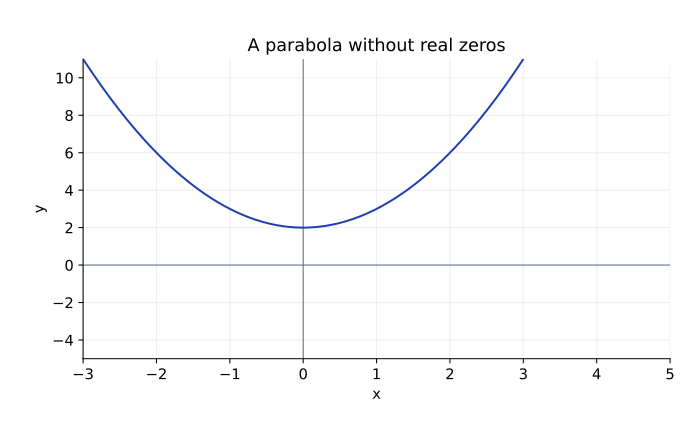
The upward parabola y = x squared + 2 stays above the horizontal axis.
Compare the graph with the sign of the discriminant.
Show worked solution

Here D=02−4(1)(2)=−8<0\displaystyle D=0^2-4(1)(2)=-8<0. The graph stays above the x-axis, so there are no real zeros.
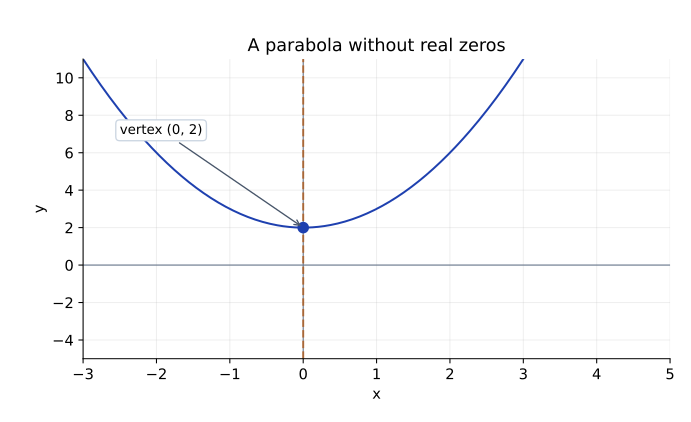
The upward parabola y = x squared + 2 stays above the horizontal axis. The discriminant is −8 and there are no real zeros.
The discriminant is −8 and there are no real zeros.

Need help with this topic?

Work through questions with a tutor and get help with the steps you find difficult.

Get help with this topic