Algebra 2 Honors · Lesson 1.1

Function Notation, Domain, and Range

How it works

A function assigns exactly one output to each permitted input. Evaluate by replacing every occurrence of the variable. A real-valued square root requires a nonnegative radicand, and a denominator cannot be zero. Range describes actual outputs and may be narrower than all real numbers.

f(a) means substitute a for the input.f(a)\text{ means substitute }a\text{ for the input.}

Worked examples

Example 1

For f(x)=x2−3x\displaystyle f(x)=x^2-3x, find f(−2)\displaystyle f(-2).

f(−2)=(−2)2−3(−2)=4+6=10\displaystyle f(-2)=(-2)^2-3(-2)=4+6=10.

Example 2

Find the domain of g(x)=x−4\displaystyle g(x)=\sqrt{x-4}.

The radicand must satisfy x−4≥0\displaystyle x-4\ge0, so the domain is [4,∞)\displaystyle [4,\infty).

Problems

Problem 1.1.1

Find the domain of f(x)=1/(x+3)\displaystyle f(x)=1/(x+3).

Show worked solution

The denominator cannot be zero, so x≠−3\displaystyle x\ne-3. The domain is all real numbers except −3\displaystyle -3.

Problem 1.1.2

Find the domain of g(x)=7−2x\displaystyle g(x)=\sqrt{7-2x}.

Show worked solution

7−2x≥0\displaystyle 7-2x\ge0, giving x≤7/2\displaystyle x\le7/2. The domain is (−∞,7/2]\displaystyle (-\infty,7/2].

Problem 1.1.3

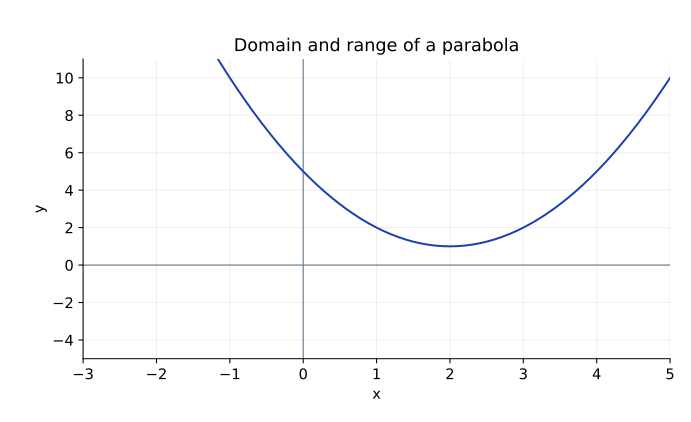
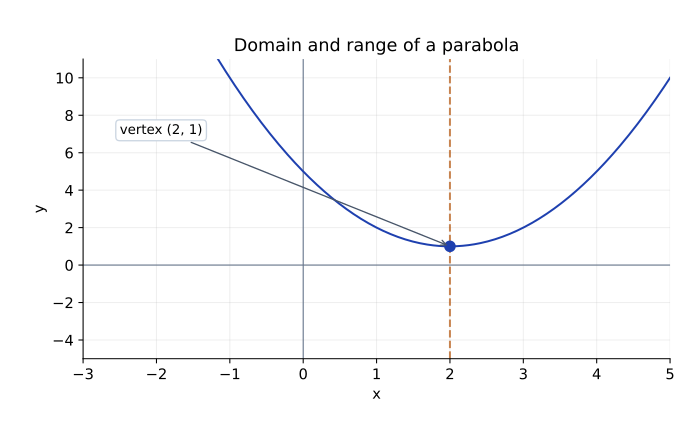
Use the graph of f(x)=(x−2)2+1\displaystyle f(x)=(x-2)^2+1 to give its domain and range.

The upward parabola y = (x − 2) squared + 1 has its minimum at height 1.
Compare allowed inputs with actual outputs.
Show worked solution

Every real input is allowed, so the domain is R\displaystyle \mathbb{R}. The minimum output is 1\displaystyle 1, so the range is [1,∞)\displaystyle [1,\infty).

The upward parabola y = (x − 2) squared + 1 has its minimum at height 1. Domain: all real numbers; range: y ≥ 1.
Domain: all real numbers; range: y ≥ 1.

Need help with this topic?

Work through questions with a tutor and get help with the steps you find difficult.

Get help with this topic