Algebra 2 Honors · Lesson 1.2

Transformations

How it works

Transformations act on inputs and outputs in different ways. Subtracting h inside the function moves a graph right by h. Adding k outside moves it up by k. Multiplying outputs scales vertically and a negative output factor reflects across the x-axis.

g(x)=af(x−h)+kg(x)=a f(x-h)+k

Worked examples

Example 1

Describe g(x)=−2(x−3)2+1\displaystyle g(x)=-2(x-3)^2+1 relative to f(x)=x2\displaystyle f(x)=x^2.

Shift right 3\displaystyle 3, reflect across the x-axis, stretch vertically by 2\displaystyle 2, and move up 1\displaystyle 1. The vertex is (3,1)\displaystyle (3,1).

Example 2

Write the graph of y=∣x∣\displaystyle y=|x| shifted left 2\displaystyle 2 and down 5\displaystyle 5.

A left shift replaces x\displaystyle x with x+2\displaystyle x+2 and a downward shift subtracts 5\displaystyle 5: y=∣x+2∣−5\displaystyle y=|x+2|-5.

Problems

Problem 1.2.1

Describe y=3x+1−2\displaystyle y=3\sqrt{x+1}-2 relative to y=x\displaystyle y=\sqrt{x}.

Show worked solution

Shift left 1\displaystyle 1, stretch vertically by 3\displaystyle 3, and move down 2\displaystyle 2. The starting point is (−1,−2)\displaystyle (-1,-2).

Problem 1.2.2

Transform y=x2\displaystyle y=x^2 by reflecting across the x-axis and moving down 4\displaystyle 4.

Show worked solution

The resulting equation is y=−x2−4\displaystyle y=-x^2-4.

Problem 1.2.3

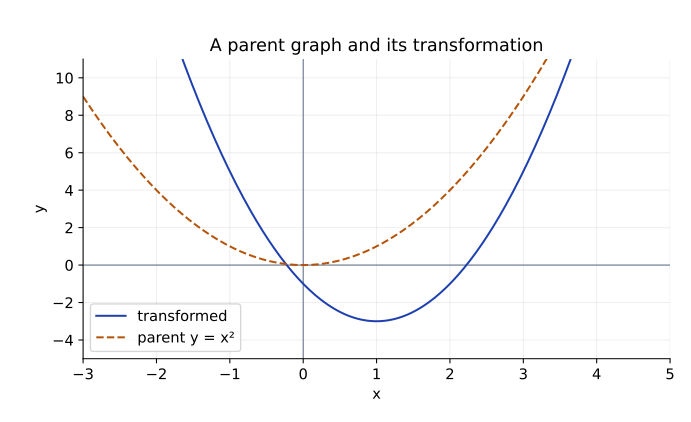
Compare the parent graph and transformed graph y=2(x−1)2−3\displaystyle y=2(x-1)^2-3. State its vertex and vertical scale.

A blue graph y = 2(x − 1) squared − 3 is compared with the dashed parent y = x squared.
Compare position, orientation, and vertical scale.
Show worked solution

The vertex moves to (1,−3)\displaystyle (1,-3) and the vertical scale factor is 2\displaystyle 2. The graph opens upward and is narrower than y=x2\displaystyle y=x^2 at the same output height above its vertex.
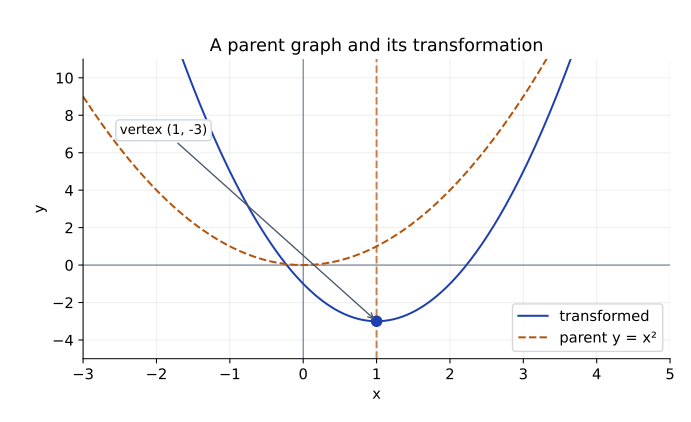
A blue graph y = 2(x − 1) squared − 3 is compared with the dashed parent y = x squared. The transformed vertex is (1, −3), with vertical scale 2.
The transformed vertex is (1, −3), with vertical scale 2.

Need help with this topic?

Work through questions with a tutor and get help with the steps you find difficult.

Get help with this topic