Algebra 2 Honors · Lesson 6.2
Interpreting Parameters
How it works
A parameter interpretation must identify its role and units. In a linear model, the intercept is the output at input zero and the slope is change per input unit. In an exponential model, a growth factor applies per chosen time unit. Values outside a plausible context may require a domain restriction.
Worked examples
Example 1
Interpret for a printing order in dollars.
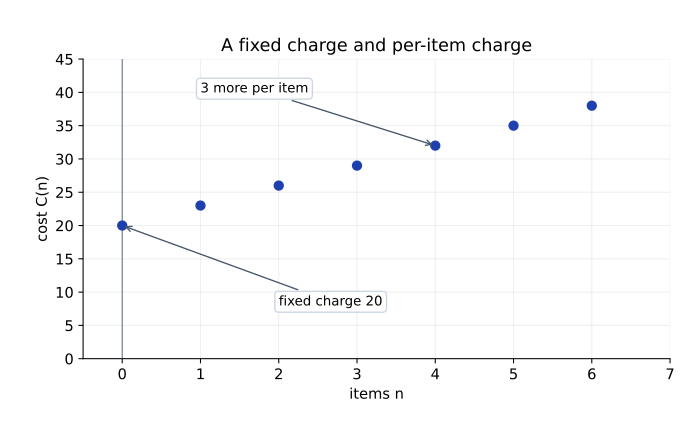
The fixed charge is and each item adds . For , the cost is .
Example 2
Interpret , where t is years.
The initial amount is units. The factor means a decrease each year, under the model assumptions.
Problems
Problem 6.2.1
A taxi model is dollars for d kilometers. Interpret both parameters.
Show worked solution
The initial charge is and the additional charge is per kilometer. A distance context requires .
Problem 6.2.2
Interpret the vertex of , measured in meters and seconds over a suitable physical interval.
Show worked solution
The modeled maximum height is meters at seconds. A physical domain should include only times relevant to the motion.
Problem 6.2.3
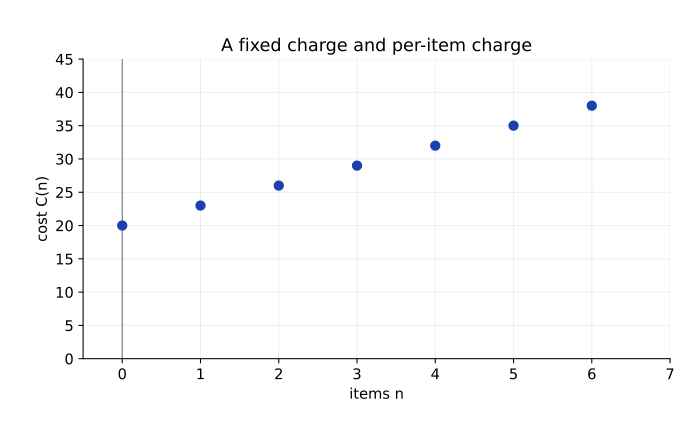
From the graph of , identify the fixed charge and charge per item, assuming nonnegative integer n.
Show worked solution
The fixed charge is , the vertical intercept. Each additional item adds , the slope. Only nonnegative integer inputs represent item counts.