Algebra and Trigonometry · Lesson 3.1

Radical Equations and Extraneous Solutions

How it works

Isolate a radical before raising both sides to a power. Squaring can introduce solutions that do not satisfy the original equation. Record the original real-domain restrictions and check every candidate in the equation before reporting it.

A=B⇒A=B2 and B≥0\sqrt{A}=B\Rightarrow A=B^2\text{ and }B\ge0

Worked examples

Example 1

Solve x+5=x−1\displaystyle \sqrt{x+5}=x-1.

The right side requires x≥1\displaystyle x\ge1. Squaring gives x+5=x2−2x+1\displaystyle x+5=x^2-2x+1, so (x−4)(x+1)=0\displaystyle (x-4)(x+1)=0. Only x=4\displaystyle x=4 checks.

Example 2

Solve 2x+3=5\displaystyle \sqrt{2x+3}=5.

Square to get 2x+3=25\displaystyle 2x+3=25, so x=11\displaystyle x=11. Substitution gives 25=5\displaystyle \sqrt{25}=5.

Problems

Problem 3.1.1

Solve x+1=3\displaystyle \sqrt{x+1}=3.

Show worked solution

x+1=9\displaystyle x+1=9, hence x=8\displaystyle x=8, which checks.

Problem 3.1.2

Solve x=x−2\displaystyle \sqrt{x}=x-2.

Show worked solution

Require x≥2\displaystyle x\ge2. Squaring gives x2−5x+4=0\displaystyle x^2-5x+4=0, so candidates are 1\displaystyle 1 and 4\displaystyle 4. Only x=4\displaystyle x=4 satisfies the original.

Problem 3.1.3

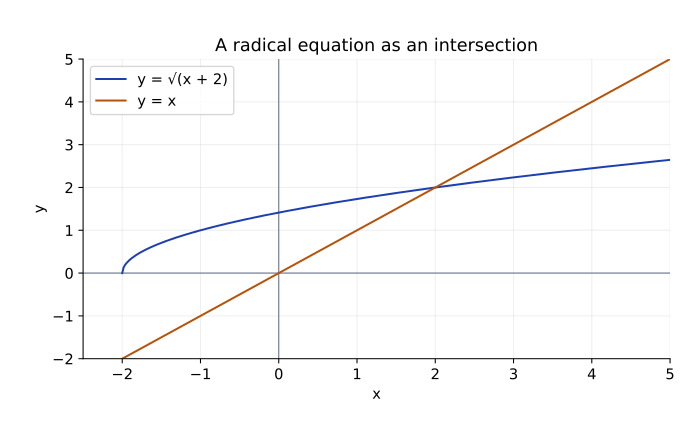
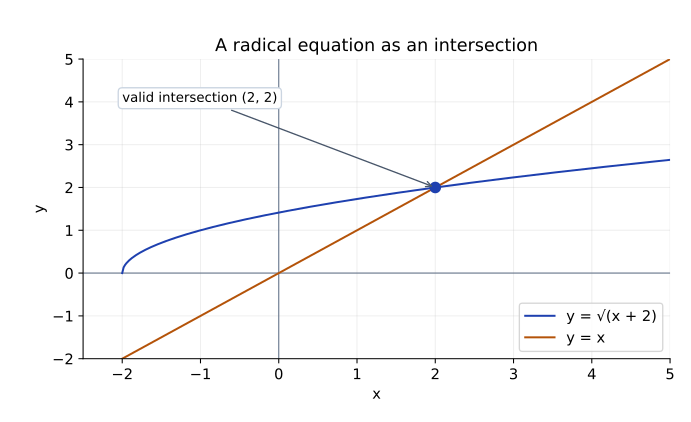
Use the graphs of y=x+2\displaystyle y=\sqrt{x+2} and y=x\displaystyle y=x to solve x+2=x\displaystyle \sqrt{x+2}=x.

The curves y = square root of (x + 2) and y = x meet at positive x.
A valid solution must satisfy the original radical equation.
Show worked solution

Squaring gives (x−2)(x+1)=0\displaystyle (x-2)(x+1)=0. The radical is nonnegative, so x=−1\displaystyle x=-1 fails. The valid intersection is (2,2)\displaystyle (2,2).

The curves y = square root of (x + 2) and y = x meet at positive x. The intersection is (2, 2); the squared-equation candidate −1 is extraneous.
The intersection is (2, 2); the squared-equation candidate −1 is extraneous.

Need help with this topic?

Work through questions with a tutor and get help with the steps you find difficult.

Get help with this topic