
Geometry Honors · Lesson 4.2
The Quadrilateral Family
How it works
A parallelogram has two pairs of parallel opposite sides. Rectangles add right angles, rhombi add four equal sides, and squares satisfy both conditions. Definitions are inclusive: every square is a rectangle and a rhombus.
Worked examples
Example 1
A parallelogram has an angle of . Find the other three angles.
The opposite angle is ; both adjacent angles are .
Example 2
A rectangle has diagonals of lengths and . Find .
Rectangle diagonals are congruent, so and .
Problems
Problem 4.2.1
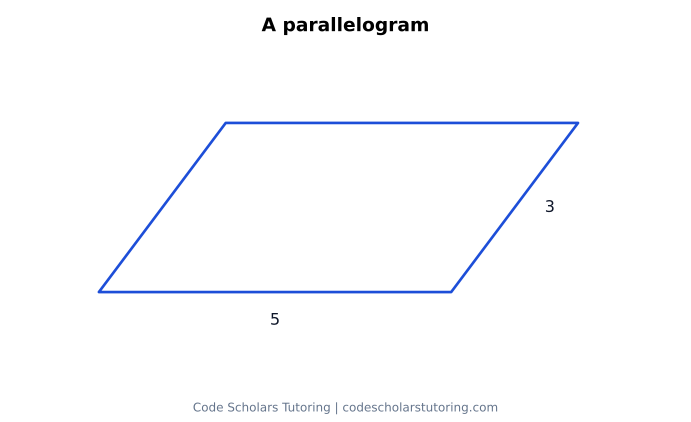
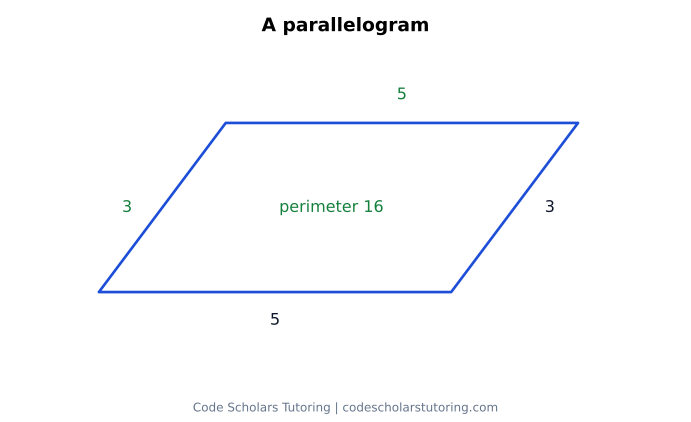
A parallelogram has adjacent side lengths and . Find its perimeter.
Show worked solution
units. Opposite sides match.
Problem 4.2.2
Does a quadrilateral with perpendicular diagonals have to be a square?
Show worked solution
No. A rhombus with unequal diagonal lengths has perpendicular diagonals but is not a square.
Problem 4.2.3
A rhombus has diagonals and . Find its side length and area.
Show worked solution
The diagonals bisect at right angles. Each side is . The area is .