Geometry Honors · Lesson 4.1

Polygon Angle Sums

How it works

A diagonal fan divides a convex polygon with n sides into n minus two triangles. The exterior angles, taking one consistent turn at each vertex, total a full revolution.

S=(n−2)180∘,Eregular=360∘nS=(n-2)180^\circ,\quad E_{\text{regular}}=\frac{360^\circ}{n}

Worked examples

Example 1

Find the sum of the interior angles of a hexagon.

S=(6−2)180∘=720∘\displaystyle S=(6-2)180^\circ=720^\circ.

Example 2

Find each interior angle of a regular octagon.

S=1080∘\displaystyle S=1080^\circ; divide by 8\displaystyle 8 to get 135∘\displaystyle 135^\circ.

Problems

Problem 4.1.1

A regular hexagon is divided from one vertex into triangles. How many triangles appear, and what is each interior angle?
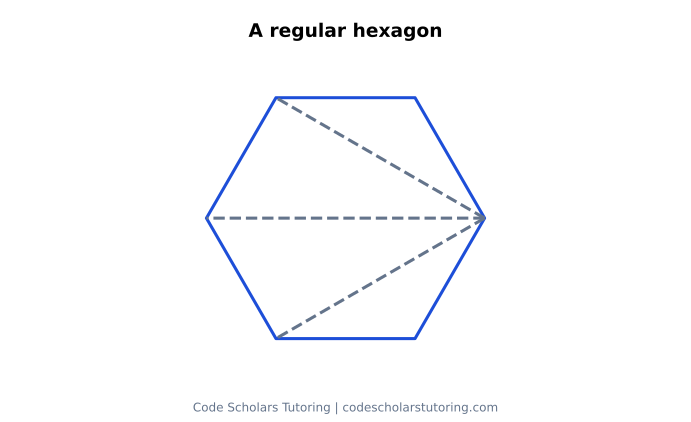
A regular hexagon split from one vertex into four triangles by three diagonals.
A diagonal fan uses n minus 2 triangles.
Show worked solution

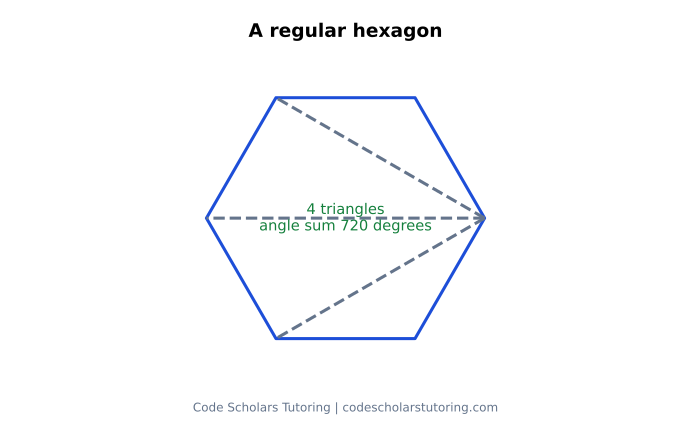
There are 6−2=4\displaystyle 6-2=4 triangles. The sum is 720∘\displaystyle 720^\circ, giving 120∘\displaystyle 120^\circ at each vertex.

A regular hexagon split from one vertex into four triangles by three diagonals. The solution adds labeled relationships.
Four triangles give 720 degrees; each regular-hexagon interior angle is 120 degrees.

Problem 4.1.2

A regular polygon has exterior angle 24∘\displaystyle 24^\circ. How many sides does it have?

Show worked solution

n=360/24=15\displaystyle n=360/24=15.

Problem 4.1.3

Five interior angles of a hexagon are 100∘,110∘,120∘,130∘,140∘\displaystyle 100^\circ,110^\circ,120^\circ,130^\circ,140^\circ. Find the sixth.

Show worked solution

Their sum is 600∘\displaystyle 600^\circ. Subtract from 720∘\displaystyle 720^\circ to obtain 120∘\displaystyle 120^\circ.

Need help with this topic?

Work through questions with a tutor and get help with the steps you find difficult.

Get help with this topic