
Precalculus · Lesson 9.2

Model Selection

How it works

Choose a model using both the numerical pattern and the context. Equal first differences suggest a linear model, equal second differences at equally spaced inputs suggest a quadratic, and a constant positive output ratio suggests an exponential. A fitted pattern does not justify unlimited extrapolation.

constant difference: linear; constant ratio: exponential\text{constant difference: linear; constant ratio: exponential}

Worked examples

Example 1

Data at x=0,1,2\displaystyle x=0,1,2 are 5,8,11\displaystyle 5,8,11. Choose a simple model.

The differences are 3,3\displaystyle 3,3, so a linear model is y=3x+5\displaystyle y=3x+5.

Example 2

Data at x=0,1,2\displaystyle x=0,1,2 are 2,6,18\displaystyle 2,6,18. Choose a simple model.

The ratios are 3,3\displaystyle 3,3, so an exponential model is y=2⋅3x\displaystyle y=2\cdot3^x.

Problems

Problem 9.2.1

Data at x=0,1,2,3\displaystyle x=0,1,2,3 are 1,4,9,16\displaystyle 1,4,9,16. Identify a simple model.

Show worked solution

First differences are 3,5,7\displaystyle 3,5,7 and second differences are 2,2\displaystyle 2,2. A fitting quadratic is y=(x+1)2\displaystyle y=(x+1)^2.

Problem 9.2.2

Data at t=0,1,2\displaystyle t=0,1,2 are 100,80,64\displaystyle 100,80,64. Identify the factor and a model.

Show worked solution

The ratio is 0.8\displaystyle 0.8, giving y=100(0.8)t\displaystyle y=100(0.8)^t.

Problem 9.2.3

The graph compares L(t)=10+5t\displaystyle L(t)=10+5t and E(t)=10(1.5)t\displaystyle E(t)=10(1.5)^t. Which has constant additive change and which has constant multiplicative change?
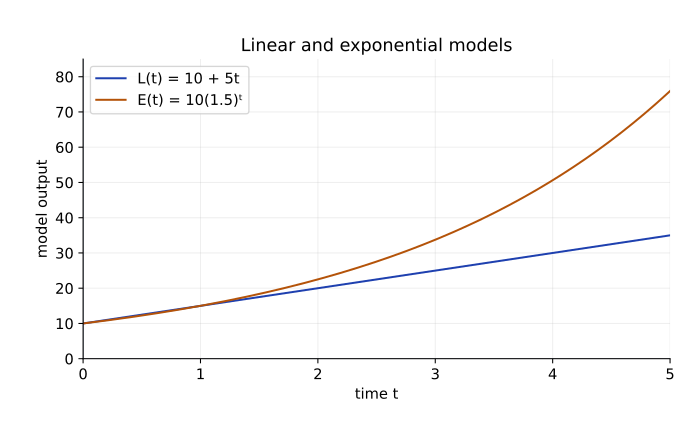
The lines and curves show L(t) = 10 + 5t and E(t) = 10 times 1.5 to the t.
Compare equal additive and equal multiplicative change.
Show worked solution

L\displaystyle L increases by 5\displaystyle 5 per time unit. E\displaystyle E multiplies by 1.5\displaystyle 1.5 per time unit, a 50%\displaystyle 50\% increase. The models agree initially but later separate.
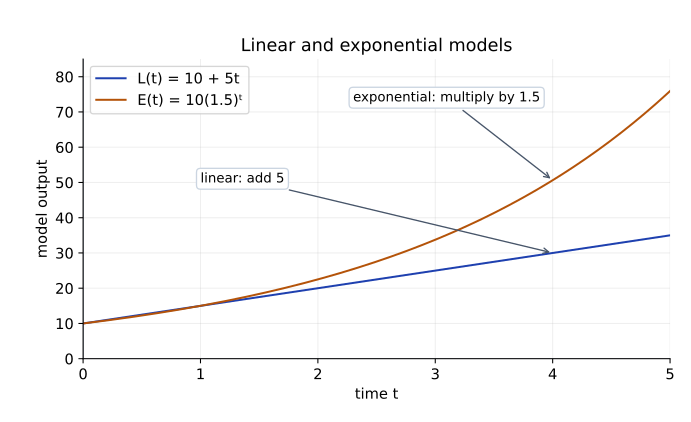
The lines and curves show L(t) = 10 + 5t and E(t) = 10 times 1.5 to the t. L adds 5 per step; E multiplies by 1.5 per step.
L adds 5 per step; E multiplies by 1.5 per step.

Need help with this topic?

Work through questions with a tutor and get help with the steps you find difficult.

Get help with this topic