Precalculus · Lesson 5.1

Amplitude, Period, and Midline

How it works

In a transformed sinusoid, the absolute outside coefficient gives amplitude, the vertical shift gives the midline, and the absolute inside frequency determines period. These interpretations use a sine or cosine model with a nonzero frequency.

y=Asin⁡(Bx)+D,amplitude=∣A∣,T=2π∣B∣y=A\sin(Bx)+D,\quad\text{amplitude}=|A|,\quad T=\frac{2\pi}{|B|}

Worked examples

Example 1

Find amplitude, period, and midline of y=3sin⁡(2x)+1\displaystyle y=3\sin(2x)+1.

Amplitude is 3\displaystyle 3, period is π\displaystyle \pi, and midline is y=1\displaystyle y=1.

Example 2

A sinusoid has maximum 9\displaystyle 9 and minimum 1\displaystyle 1. Find amplitude and midline.

Amplitude is (9−1)/2=4\displaystyle (9-1)/2=4 and midline is y=(9+1)/2=5\displaystyle y=(9+1)/2=5.

Problems

Problem 5.1.1

For y=2sin⁡x+1\displaystyle y=2\sin x+1, find amplitude, period, midline, and range.
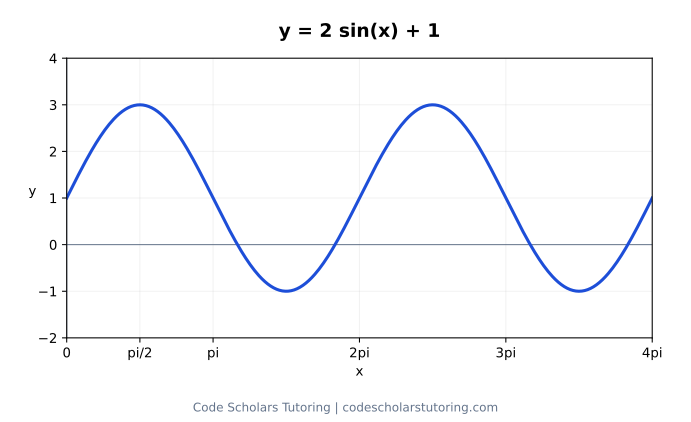
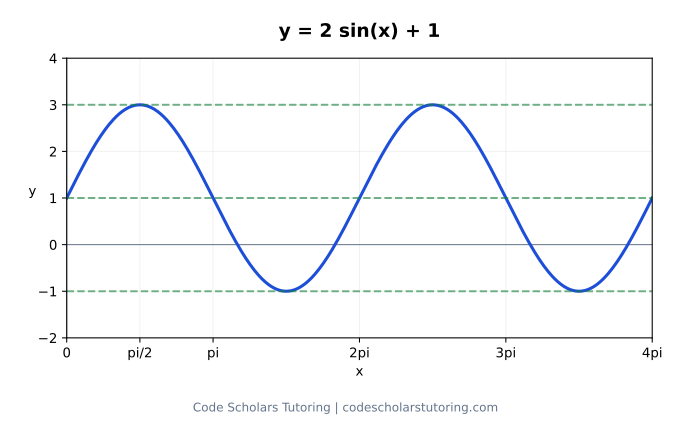
Sinusoid with maximum 3, minimum negative 1, midline 1, and period 2 pi.
Read the vertical extremes and distance between repeats.
Show worked solution

Amplitude 2\displaystyle 2, period 2π\displaystyle 2\pi, midline y=1\displaystyle y=1, and range [−1,3]\displaystyle [-1,3].

Sinusoid with maximum 3, minimum negative 1, midline 1, and period 2 pi. The solution adds labeled relationships.
Amplitude = 2, midline = 1, period = 2 pi, range [-1,3].

Problem 5.1.2

Find the period of y=−4cos⁡(3x)\displaystyle y=-4\cos(3x).

Show worked solution

The period is 2π/3\displaystyle 2\pi/3. The negative sign reflects the graph but does not change the period.

Problem 5.1.3

A sine model has period 8\displaystyle 8. Find a positive frequency coefficient.

Show worked solution

B=2π/8=π/4\displaystyle B=2\pi/8=\pi/4.

Need help with this topic?

Work through questions with a tutor and get help with the steps you find difficult.

Get help with this topic