
Algebra 1 Honors · Lesson 2.3
Inequalities and Compound Statements
How it works
An inequality describes a set of allowed values. Adding or subtracting the same quantity preserves its direction. Multiplying or dividing by a negative number reverses the direction. An AND statement requires both conditions; an OR statement permits either one.
Worked examples
Example 1
Solve .
Subtract : . Dividing by reverses the sign: .
Example 2
Solve .
Subtract throughout: . Divide by : .
Problems
Problem 2.3.1
Solve .
Show worked solution
. Divide by and reverse the relation: .
Problem 2.3.2
Solve .
Show worked solution
Subtract throughout: . The left endpoint is excluded and the right is included.
Problem 2.3.3
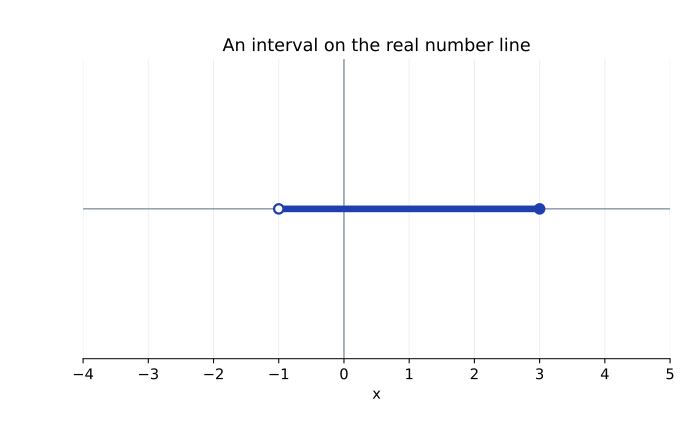
The diagram shows an interval. Write it as an inequality and in interval notation.
Show worked solution
The open point at is excluded and the filled point at is included. The set is , or .
![A blue interval runs from an open endpoint at negative 1 to a filled endpoint at 3. The interval is (−1, 3].](/downloads/algebra/graphs/a1-interval-solution.svg)