Algebra 1 Honors · Lesson 4.1

Substitution and Elimination

How it works

A solution of a system satisfies every equation simultaneously. Substitution replaces one variable using an equivalent expression. Elimination combines equations to remove a variable. Choose the method that keeps arithmetic clear, then check the ordered pair in both original equations.

A system solution lies on every equation in the system.\text{A system solution lies on every equation in the system.}

Worked examples

Example 1

Solve y=x+1\displaystyle y=x+1 and 2x+y=7\displaystyle 2x+y=7.

Substitute: 2x+x+1=7\displaystyle 2x+x+1=7, so x=2\displaystyle x=2 and y=3\displaystyle y=3. Both original equations hold.

Example 2

Solve x+y=9\displaystyle x+y=9 and x−y=3\displaystyle x-y=3.

Add the equations: 2x=12\displaystyle 2x=12, so x=6\displaystyle x=6. Substitute to obtain y=3\displaystyle y=3.

Problems

Problem 4.1.1

Solve y=2x\displaystyle y=2x and x+y=12\displaystyle x+y=12.

Show worked solution

x+2x=12\displaystyle x+2x=12, so x=4\displaystyle x=4 and y=8\displaystyle y=8.

Problem 4.1.2

Solve 2x+y=8\displaystyle 2x+y=8 and 2x−y=4\displaystyle 2x-y=4.

Show worked solution

Add: 4x=12\displaystyle 4x=12, giving x=3\displaystyle x=3. Then y=2\displaystyle y=2.

Problem 4.1.3

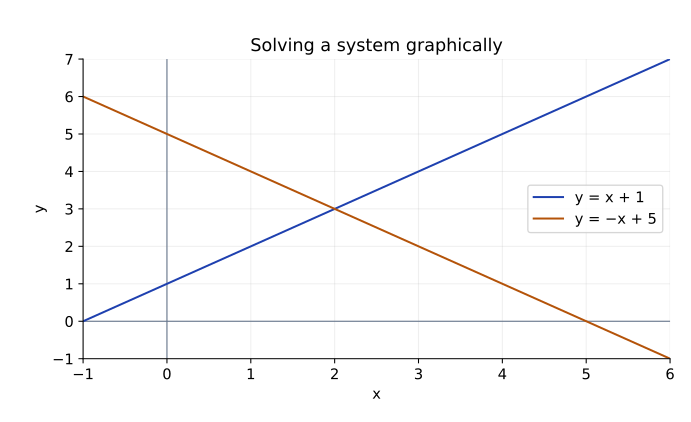
Use the graph to solve the system y=x+1\displaystyle y=x+1, y=−x+5\displaystyle y=-x+5.

The lines y = x + 1 and y = −x + 5 cross once.
The solution must lie on both lines.
Show worked solution

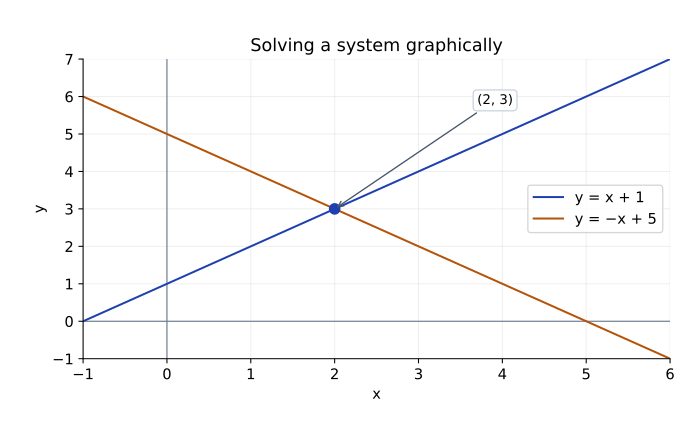
The two lines meet at (2,3)\displaystyle (2,3). Algebra confirms x+1=−x+5\displaystyle x+1=-x+5, so x=2\displaystyle x=2 and y=3\displaystyle y=3.

The lines y = x + 1 and y = −x + 5 cross once. The intersection is (2, 3).
The intersection is (2, 3).

Need help with this topic?

Work through questions with a tutor and get help with the steps you find difficult.

Get help with this topic