Algebra and Trigonometry · Lesson 5.2

Unit Circle Coordinates

How it works

A point on the unit circle at angle theta has coordinates cosine theta and sine theta. Reference angles give magnitudes, while the quadrant sets signs. Angles that differ by full revolutions reach the same point.

(x,y)=(cos⁡θ,sin⁡θ),x2+y2=1(x,y)=(\cos\theta,\sin\theta),\quad x^2+y^2=1

Worked examples

Example 1

Find the unit-circle point at π/3\displaystyle \pi/3.

The point is (1/2,3/2)\displaystyle (1/2,\sqrt{3}/2).

Example 2

Find the unit-circle point at 5π/6\displaystyle 5\pi/6.

The reference angle is π/6\displaystyle \pi/6 and the point is in quadrant II: (−3/2,1/2)\displaystyle (-\sqrt{3}/2,1/2).

Problems

Problem 5.2.1

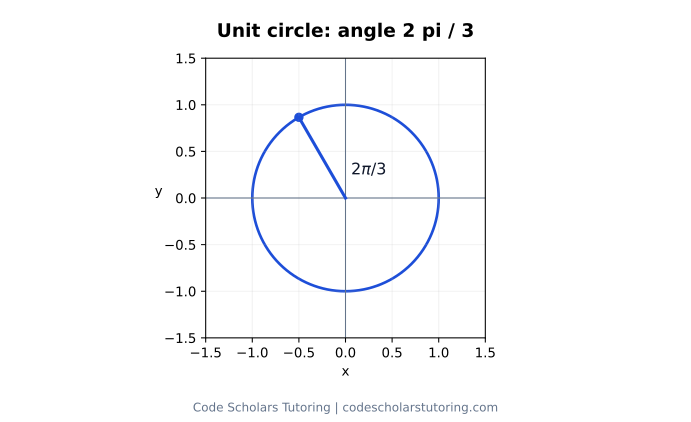
Find the unit-circle coordinates at 2π/3\displaystyle 2\pi/3.

Unit circle with the terminal radius at 120 degrees in quadrant II.
Cosine is the horizontal coordinate and sine the vertical coordinate.
Show worked solution

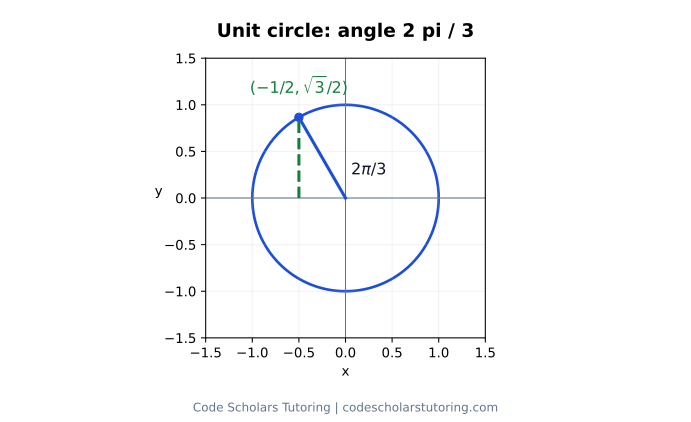
The reference angle is π/3\displaystyle \pi/3; quadrant II gives (−1/2,3/2)\displaystyle (-1/2,\sqrt{3}/2).

Unit circle with the terminal radius at 120 degrees in quadrant II. The solution adds labeled relationships.
The terminal point is (-1/2, sqrt(3)/2); tangent is -sqrt(3).

Problem 5.2.2

Find sin⁡(7π/6)\displaystyle \sin(7\pi/6) and cos⁡(7π/6)\displaystyle \cos(7\pi/6).

Show worked solution

Quadrant III makes both negative: sin⁡=−1/2\displaystyle \sin=-1/2 and cos⁡=−3/2\displaystyle \cos=-\sqrt{3}/2.

Problem 5.2.3

Give a positive coterminal angle for −π/4\displaystyle -\pi/4 in [0,2π)\displaystyle [0,2\pi).

Show worked solution

Add 2π\displaystyle 2\pi to get 7π/4\displaystyle 7\pi/4.

Need help with this topic?

Work through questions with a tutor and get help with the steps you find difficult.

Get help with this topic