
Build a derivative
Use the definition to find for .
- Form .
- Expand and cancel for : the quotient is .
- Take to obtain .
Calculus Honors · AP-aligned study guide
Build the derivative from average rates, connect its value to a tangent slope, and decide where differentiability fails.
AP 2.1–2.4 · Reading: Larson & Edwards §2.1
For a position function , average velocity on is . This is the slope of a secant line through two points on the position graph. Keep while simplifying.
The derivative is the limit of secant slopes as the second input approaches the first. If this finite limit exists, it gives instantaneous velocity or tangent slope. Its units are output units per input unit.
For , expand . For , division by gives . Only after simplification take the limit to obtain .
The alternate definition uses the same secant geometry. Recognize either form when a limit is presented as a derivative.
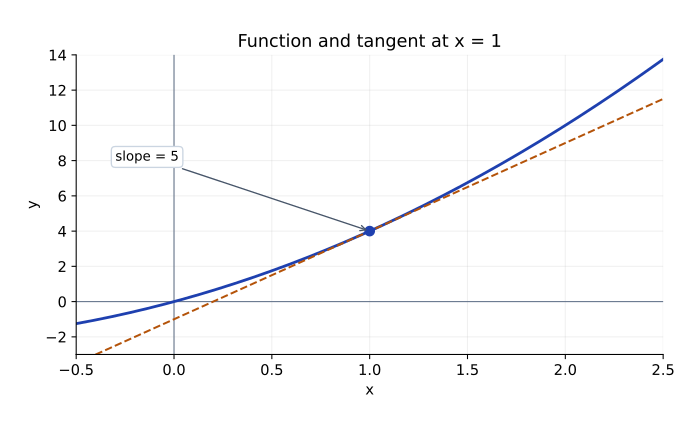
A tangent line passes through with slope . Use point-slope form rather than substituting the slope as a height. For a height measured in meters over seconds, a derivative value of means an instantaneous rise of meters per second.
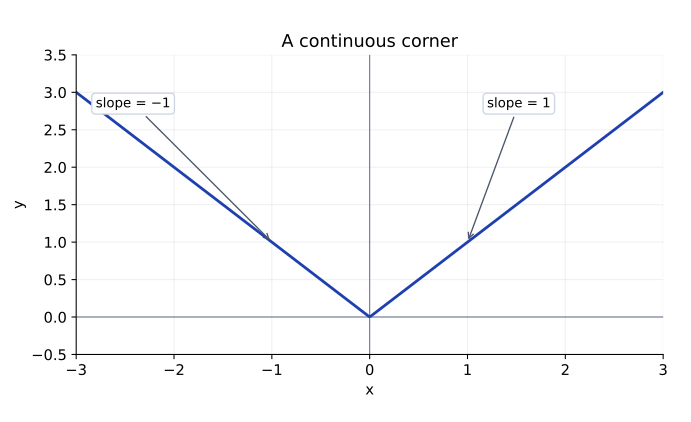
Differentiability implies continuity, but continuity alone is insufficient. The graph of is continuous at , yet the left slopes approach and right slopes approach . Corners, cusps, vertical tangents, and discontinuities require separate analysis.
Use the definition to find for .
Find the tangent to at .
No calculator required.
1. Use the limit definition to find for . Write its tangent line.
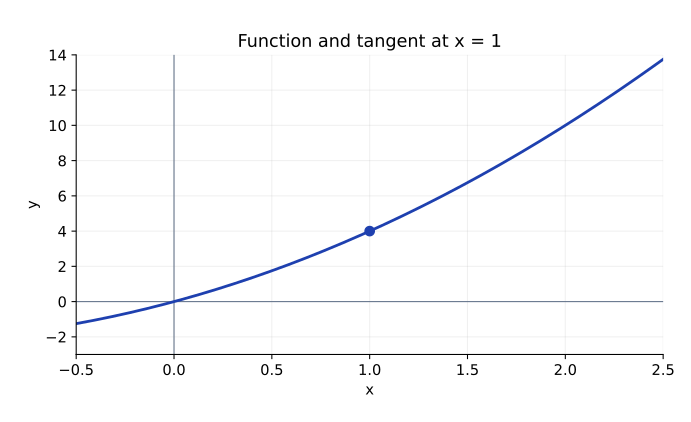
The difference quotient simplifies to . Its limit is . Since , the tangent is , or .
2. Is differentiable at ? Use one-sided slopes.
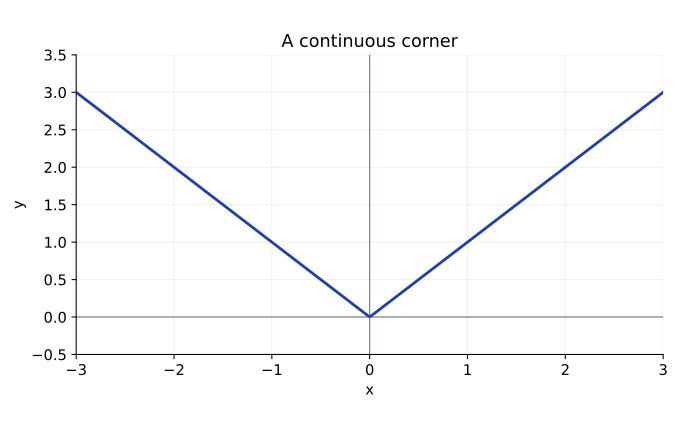
The left difference quotients equal , while the right quotients equal . Since their limits differ, does not exist, although is continuous.
3. Express as a derivative and evaluate it.
This is for . The quotient is , so the limit is .
Work through questions with a tutor and get help with the steps you find difficult.
Get help with this topic