1.5 · Infinite limits, limits at infinity, and asymptotes
Separate unbounded output near a finite input from end behavior, use sign analysis, and identify vertical and horizontal asymptotes.
AP topics 1.14–1.15 · Reading: Larson & Edwards §§1.5, 3.5 (end behavior moved into Unit 1)
Learning objectives
Use one-sided signs to describe infinite limits near a vertical asymptote.
Distinguish infinite limits from limits at infinity.
Evaluate rational end behavior using dominant powers.
Handle square roots at negative infinity using √(x²) = |x|.
Two different roles for infinity
In x→alimf(x)=+∞, the input approaches a finite number while the output grows beyond every positive bound. This is an infinite limit; infinity is not a real number that you substitute or reach. A finite real limit does not exist in this situation.
In x→+∞limf(x)=L, the inputs grow without bound and the outputs approach a finite height L. This is a limit at infinity and describes end behavior. Always identify whether infinity is attached to the input or to the output.
x→a+limf(x)=+∞versusx→+∞limf(x)=L
Use signs near a vertical asymptote
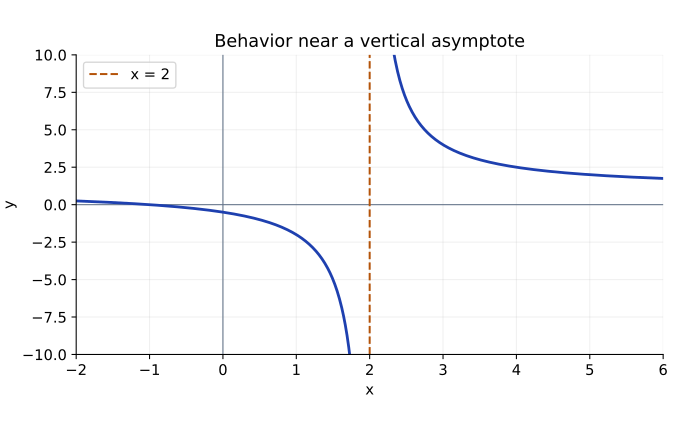
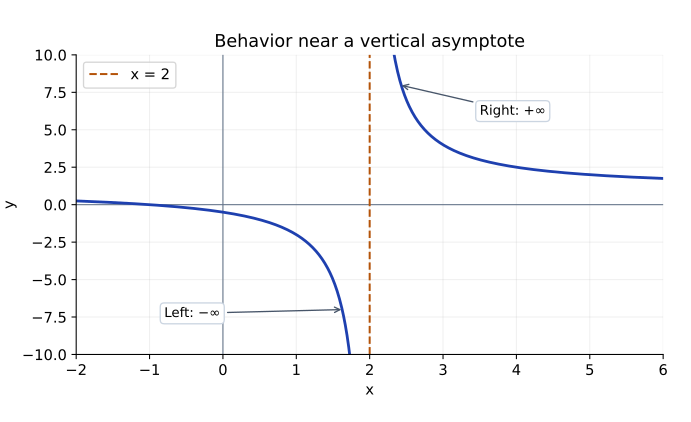
The line x = a is a vertical asymptote when at least one one-sided limit is +∞ or −∞. For x−21, the denominator is negative just left of 2 and positive just right of 2. Thus the left-hand limit is −∞ and the right-hand limit is +∞. The two-sided limit does not exist.
For (x−2)21, both sides approach +∞ because the denominator is positive and approaches zero. It is valid to write a two-sided infinite limit of +∞, while recognizing that no finite real limit exists. A squared factor can make the signs agree.
x→2−limx−21=−∞,x→2+limx−21=+∞
A zero denominator is a candidate, not a conclusion
First factor the rational expression. A fully canceled denominator factor may produce a removable hole rather than a vertical asymptote: x−2x2−4 agrees with x + 2 away from 2 and has a finite limit there.
A remaining denominator factor may produce unbounded behavior. For (x−2)(x+3)x+1 near 2, the numerator and x + 3 are positive. The factor x − 2 controls the sign, giving −∞ from the left and +∞ from the right. Check signs on each side instead of simply writing “infinity.”
Find rational end behavior with dominant powers
For x→+∞lim2x2−x3x2+1, divide numerator and denominator by x². The expression becomes 2−1/x3+1/x2. As x grows, the terms involving reciprocal powers approach 0, leaving 23. The same limit holds at negative infinity.
After any cancellation, if the numerator degree is smaller than the denominator degree, the limit is 0. If the degrees match, the limit is the ratio of leading coefficients. If the numerator degree is larger, there is no finite horizontal-asymptote limit; use the leading term and the direction of approach to determine signs.
x→±∞lim2x2−x3x2+1=23
Horizontal asymptotes describe the ends
If x→+∞limf(x)=L or x→−∞limf(x)=L, then y = L is a horizontal asymptote for that end. The limits at the two ends can differ. A horizontal asymptote is not a barrier: a curve may cross it at finite inputs.
For f(x) = x2+1x, the end limits are 0, giving y = 0 as a horizontal asymptote. Yet f(0) = 0, so the curve crosses that asymptote. Vertical and horizontal asymptotes describe different kinds of limiting behavior.
Square roots require an absolute value
The identity x2=∣x∣ holds for every real x. For positive x, x∣x∣=1; for negative x, x∣x∣=−1. Ignoring this distinction gives incorrect limits at negative infinity.
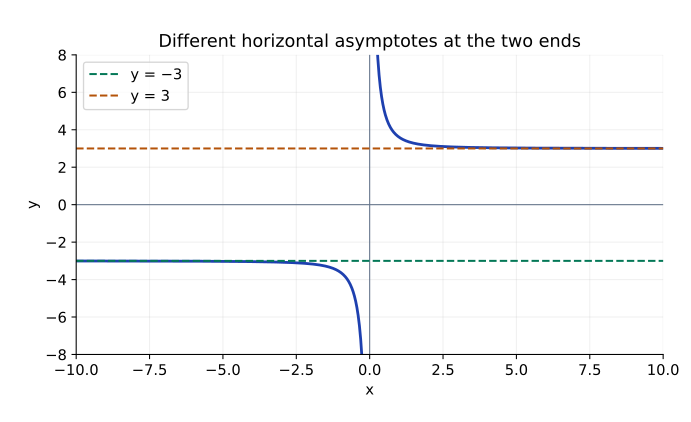
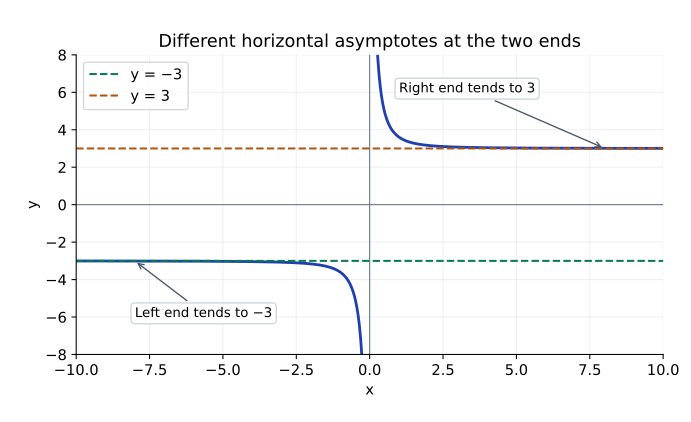
For xx2+9, factor x² from under the radical to get x∣x∣1+x29. The radical approaches 1 at either end, but the first factor is 1 as x approaches positive infinity and −1 as x approaches negative infinity. The two horizontal asymptotes are y = 1 and y = −1.
xx2+9=x∣x∣1+x29
Worked examples
Analyze signs on both sides
Find both one-sided limits of (x−1)2x+2 at x=1 and identify the vertical asymptote.
The numerator approaches 3>0.
The squared denominator is positive and approaches 0 from both sides.
Thus x→1−lim(x−1)2x+2=+∞ and x→1+lim(x−1)2x+2=+∞.
The vertical asymptote is x=1. The two-sided infinite limit is +∞; there is no finite real limit.
Different behavior at the two ends
Evaluate x→+∞limx4x2+1 and x→−∞limx4x2+1.
Rewrite as x∣x∣4+x21.
At positive infinity, x∣x∣=1, so the limit is 2.
At negative infinity, x∣x∣=−1, so the limit is −2.
The horizontal asymptotes are y=2 at the right end and y=−2 at the left end.
Common mistakes
Treating infinity as a number that can be directly substituted.
Calling every zero denominator a vertical asymptote without factoring.
Reporting an infinite limit without checking the sign on each side.
Assuming the limits at positive and negative infinity always agree.
Replacing √(x²) with x when x is negative.
Try it yourself
No calculator required.
1. Find x→2−limx−2x+1 and x→2+limx−2x+1. Does the two-sided limit exist? Identify the vertical asymptote.
Follow each branch as x approaches the dashed line.Show worked solution
The numerator approaches 3>0. The denominator is negative to the left and positive to the right, so x→2−limx−2x+1=−∞ and x→2+limx−2x+1=+∞. The two-sided limit does not exist. The vertical asymptote is x=2.
The left branch tends to negative infinity and the right branch to positive infinity.
2. Evaluate x→+∞lim2x2+7x5x2−3. Identify the horizontal asymptote.
Show worked solution
Divide by x2 to obtain 2+7/x5−3/x2. The reciprocal terms approach 0, so the limit is 25. The horizontal asymptote is y=25.
3. Evaluate x→−∞limx9x2+4. Explain the sign.
Compare end behavior on the negative and positive sides.Show worked solution
Rewrite the quotient as x∣x∣9+x24. For negative x, x∣x∣=−1, while the radical approaches 3. Therefore the limit is −3.
At negative infinity, the curve approaches y = minus 3 because absolute x over x equals minus 1.
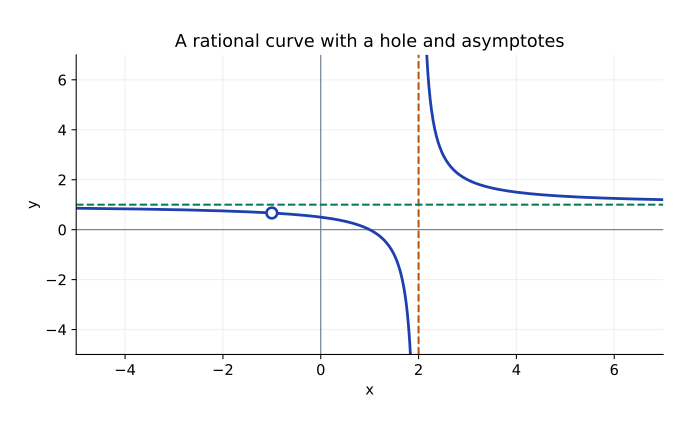
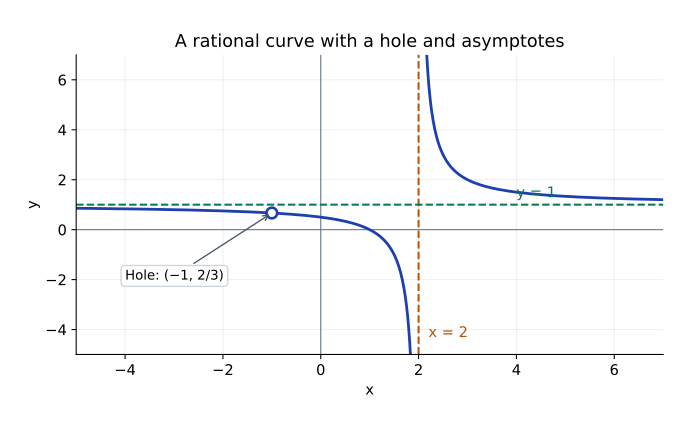
4. For f(x)=x2−x−2x2−1, classify the excluded inputs and find both end limits.
A canceled factor creates a hole; the remaining denominator factor creates an asymptote.Show worked solution
Factor to get (x−2)(x+1)(x−1)(x+1). The excluded inputs are −1 and 2. At −1 there is a removable hole with limit 32. At 2 a denominator factor remains and the numerator is nonzero, giving a vertical asymptote x=2. Equal leading degrees give x→±∞limf(x)=1, so y=1 is a horizontal asymptote.
The hole is at (minus 1, two thirds), with asymptotes x = 2 and y = 1.