Geometry Honors · Lesson 5.2

Circle Equations

How it works

A circle is the set of points a fixed distance from a center. Read the center after writing the equation in squared form. Complete the square in both variables to convert an expanded equation.

(x−h)2+(y−k)2=r2(x-h)^2+(y-k)^2=r^2

Worked examples

Example 1

Find the center and radius of (x−2)2+(y+3)2=25\displaystyle (x-2)^2+(y+3)^2=25.

The center is (2,−3)\displaystyle (2,-3) and the radius is 5\displaystyle 5.

Example 2

Convert x2+y2−4x+6y−12=0\displaystyle x^2+y^2-4x+6y-12=0 to standard form.

Complete squares: (x−2)2+(y+3)2=25\displaystyle (x-2)^2+(y+3)^2=25. The added constants are 4\displaystyle 4 and 9\displaystyle 9.

Problems

Problem 5.2.1

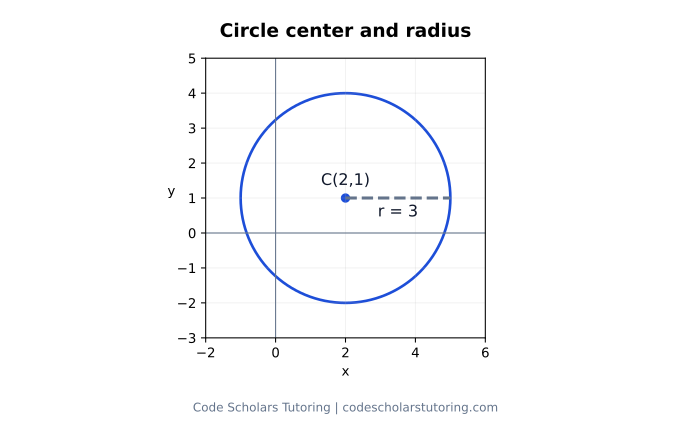
Write the equation of a circle with center (2,1)\displaystyle (2,1) and radius 3\displaystyle 3.

Circle centered at 2,1 with radius 3 and a marked horizontal radius.
The center and radius determine the standard-form equation.
Show worked solution

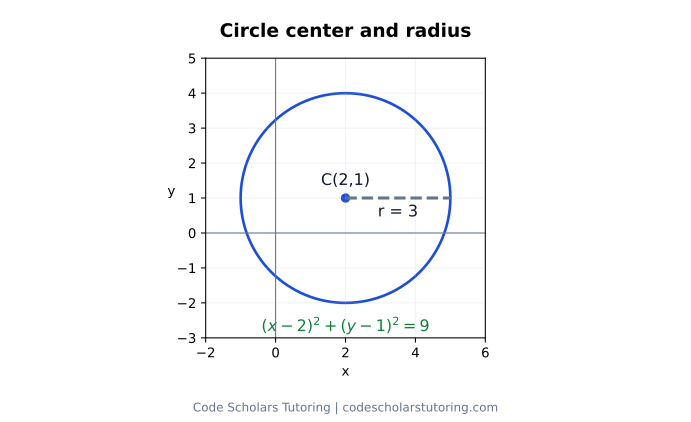
Use the center-radius form: (x−2)2+(y−1)2=9\displaystyle (x-2)^2+(y-1)^2=9.

Circle centered at 2,1 with radius 3 and a marked horizontal radius. The solution adds labeled relationships.
Subtract center coordinates inside the squares; use radius squared on the right.

Problem 5.2.2

Does (5,1)\displaystyle (5,1) lie on the circle (x−2)2+(y−1)2=9\displaystyle (x-2)^2+(y-1)^2=9?

Show worked solution

Yes. Substitution gives 32+02=9\displaystyle 3^2+0^2=9.

Problem 5.2.3

A diameter has endpoints (−2,1)\displaystyle (-2,1) and (4,1)\displaystyle (4,1). Write the circle equation.

Show worked solution

The midpoint is (1,1)\displaystyle (1,1), and half the diameter is 3\displaystyle 3. Thus (x−1)2+(y−1)2=9\displaystyle (x-1)^2+(y-1)^2=9.

Need help with this topic?

Work through questions with a tutor and get help with the steps you find difficult.

Get help with this topic