Geometry Honors · Lesson 5.3

Conic Sections

How it works

Standard forms distinguish circles, ellipses, parabolas, and hyperbolas. For an ellipse, the larger denominator gives the major axis. For a hyperbola, the positive squared term gives the transverse-axis direction.

x2a2+y2b2=1(a>b>0)\frac{x^2}{a^2}+\frac{y^2}{b^2}=1\quad(a>b>0)

Worked examples

Example 1

Identify x2/25+y2/9=1\displaystyle x^2/25+y^2/9=1 and find its vertices.

It is an ellipse centered at the origin with horizontal major axis. Its major vertices are (±5,0)\displaystyle (\pm5,0).

Example 2

For y2=8x\displaystyle y^2=8x, find the focus and directrix.

Compare y2=4px\displaystyle y^2=4px: p=2\displaystyle p=2. The focus is (2,0)\displaystyle (2,0) and directrix is x=−2\displaystyle x=-2.

Problems

Problem 5.3.1

For x2/25+y2/9=1\displaystyle x^2/25+y^2/9=1, find the foci.

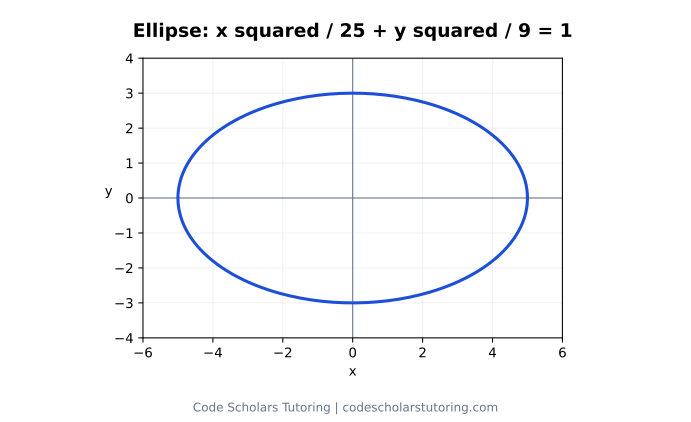
Ellipse with horizontal semiaxis 5 and vertical semiaxis 3.
The major axis is horizontal because 25 is the larger denominator.
Show worked solution

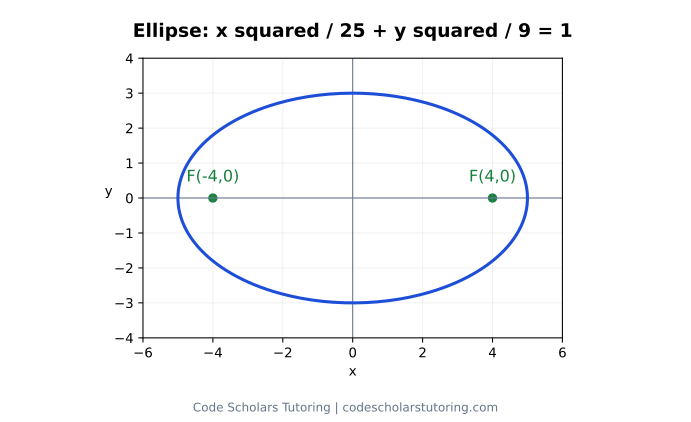
c2=a2−b2=25−9=16\displaystyle c^2=a^2-b^2=25-9=16, so the foci are (±4,0)\displaystyle (\pm4,0).

Ellipse with horizontal semiaxis 5 and vertical semiaxis 3. The solution adds labeled relationships.
The focal distance is sqrt(25 - 9) = 4.

Problem 5.3.2

Find the vertices and asymptotes of x2/9−y2/4=1\displaystyle x^2/9-y^2/4=1.

Show worked solution

Vertices: (±3,0)\displaystyle (\pm3,0). Asymptotes: y=±(2/3)x\displaystyle y=\pm(2/3)x.

Problem 5.3.3

Explain why x2+y2=−1\displaystyle x^2+y^2=-1 has no real graph.

Show worked solution

Each square is nonnegative, so their sum cannot equal −1\displaystyle -1.

Need help with this topic?

Work through questions with a tutor and get help with the steps you find difficult.

Get help with this topic