
Geometry Honors · Lesson 2.3
Constructions
How it works
A compass preserves distances and a straightedge draws lines through constructed points. The perpendicular bisector consists of points equidistant from the endpoints; an angle bisector consists of interior points equidistant from the two sides.
Worked examples
Example 1
Describe constructing the perpendicular bisector of .
Use the same compass radius greater than half from each endpoint. Join the two intersections of the arcs. This line passes through the midpoint and is perpendicular to .
Example 2
Why do the intersecting arcs construction points lie on the perpendicular bisector?
Each intersection has equal distance from and because both arcs use the same radius. The equidistance locus is the perpendicular bisector.
Problems
Problem 2.3.1
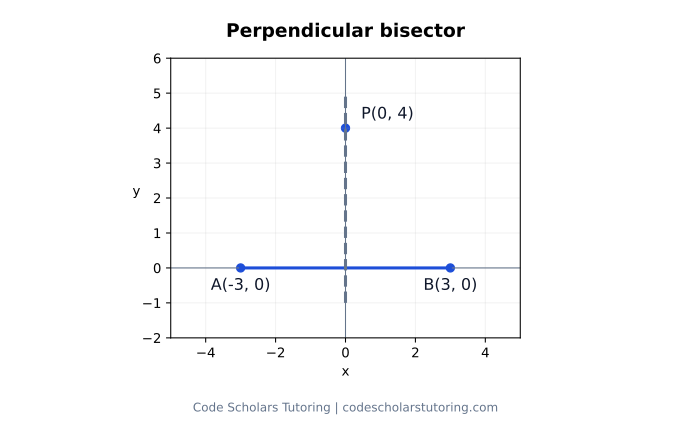
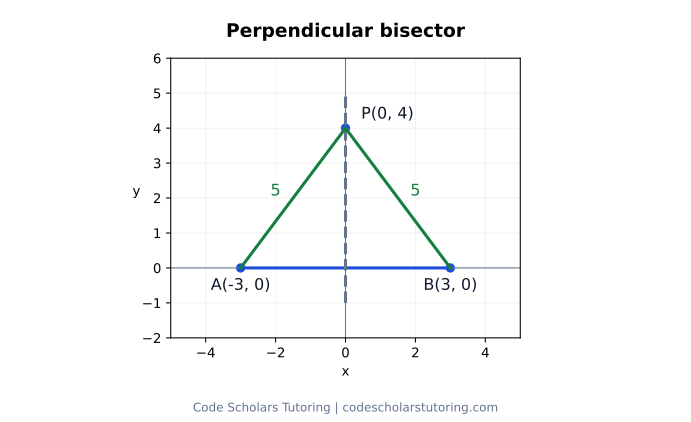
For and , give the perpendicular bisector and verify that lies on it.
Show worked solution
The midpoint is , and the bisector is . Also .
Problem 2.3.2
Outline the construction of an angle bisector.
Show worked solution
Draw an arc centered at the vertex meeting both rays. From those two intersection points draw equal-radius intersecting arcs inside the angle. Join the vertex to their intersection.
Problem 2.3.3
Why must the radius exceed half the segment length in the perpendicular-bisector construction?
Show worked solution
Otherwise the two circles have fewer than two intersection points, so they do not determine the required line.