Precalculus · Lesson 8.3

Polar Graphs and Symmetry

How it works

Read a polar graph by tracking signed radius as the angle changes. Testing substitutions can establish symmetry, but failing one particular test does not prove absence of symmetry because polar representations are not unique.

r=2cos⁡θ⟺(x−1)2+y2=1r=2\cos\theta\quad\Longleftrightarrow\quad(x-1)^2+y^2=1

Worked examples

Example 1

Identify the graph r=3\displaystyle r=3.

It is the circle centered at the pole with radius 3\displaystyle 3.

Example 2

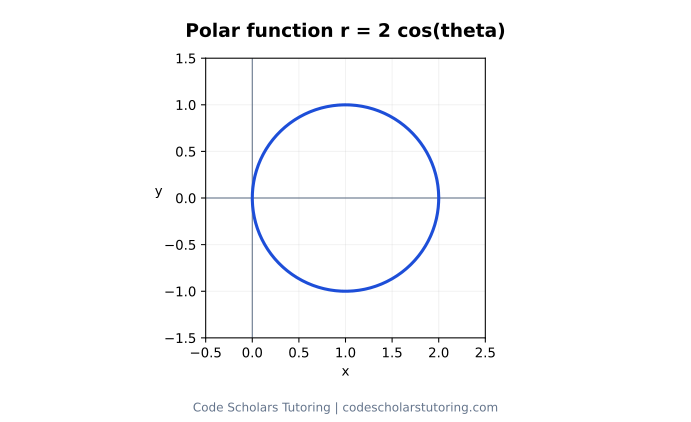
Identify r=2cos⁡θ\displaystyle r=2\cos\theta.

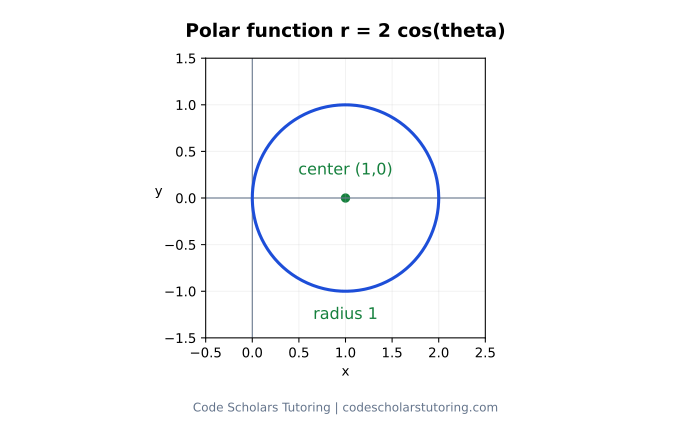
Converting gives x2+y2=2x\displaystyle x^2+y^2=2x, a circle centered at (1,0)\displaystyle (1,0) with radius 1\displaystyle 1.

Problems

Problem 8.3.1

For r=2cos⁡θ\displaystyle r=2\cos\theta, find points at θ=0,π/3,π/2\displaystyle \theta=0,\pi/3,\pi/2.

A circle centered at 1,0 with radius 1, passing through the pole and 2,0.
Signed radii trace a circle even when the radius is negative.
Show worked solution

The radii are 2,1,0\displaystyle 2,1,0. Cartesian points are (2,0),(1/2,3/2),(0,0)\displaystyle (2,0),(1/2,\sqrt{3}/2),(0,0).

A circle centered at 1,0 with radius 1, passing through the pole and 2,0. The solution adds labeled relationships.
The Cartesian equation is (x - 1)^2 + y^2 = 1.

Problem 8.3.2

Does r=2cos⁡θ\displaystyle r=2\cos\theta have symmetry across the polar axis?

Show worked solution

Yes. Replacing theta with its negative leaves cosine and the equation unchanged.

Problem 8.3.3

For r=1+cos⁡θ\displaystyle r=1+\cos\theta, find the maximum radius and an angle where the graph reaches the pole.

Show worked solution

The maximum radius is 2\displaystyle 2 at θ=0\displaystyle \theta=0; the pole occurs at θ=π\displaystyle \theta=\pi.

Need help with this topic?

Work through questions with a tutor and get help with the steps you find difficult.

Get help with this topic