Precalculus · Lesson 8.2

Conversion

How it works

Convert polar to Cartesian using cosine and sine. For the reverse direction, compute the nonnegative radius and choose the angle using the quadrant, not only a tangent ratio. The origin has no unique angle.

x=rcos⁡θ,y=rsin⁡θ,r2=x2+y2x=r\cos\theta,\quad y=r\sin\theta,\quad r^2=x^2+y^2

Worked examples

Example 1

Convert (r,θ)=(2,π/6)\displaystyle (r,\theta)=(2,\pi/6) to Cartesian coordinates.

The coordinates are (3,1)\displaystyle (\sqrt{3},1).

Example 2

Convert (−1,3)\displaystyle (-1,\sqrt{3}) to polar coordinates with positive radius and angle in [0,2π)\displaystyle [0,2\pi).

The radius is 2\displaystyle 2. Quadrant II gives angle 2π/3\displaystyle 2\pi/3.

Problems

Problem 8.2.1

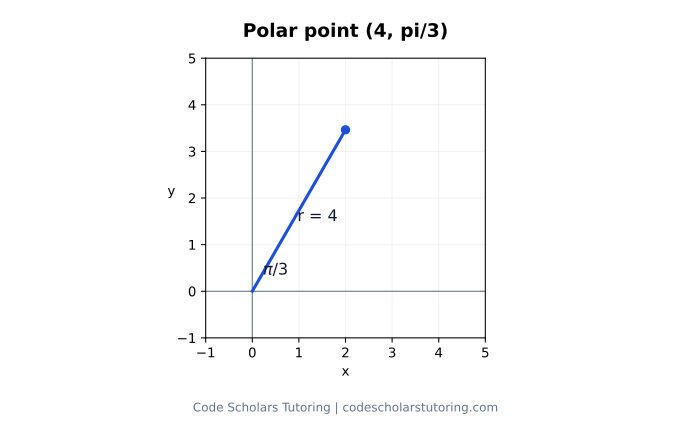
Convert (r,θ)=(4,π/3)\displaystyle (r,\theta)=(4,\pi/3) to Cartesian coordinates.

A radius of length 4 makes an angle pi/3 with the positive horizontal axis.
Use x = r cos(theta) and y = r sin(theta).
Show worked solution

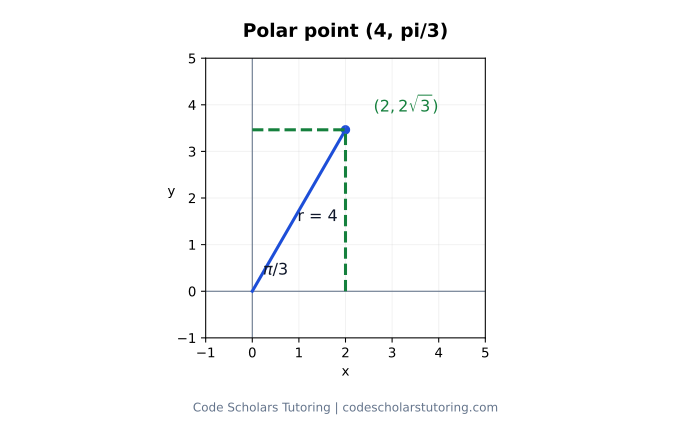
The coordinates are (2,23)\displaystyle (2,2\sqrt{3}).

A radius of length 4 makes an angle pi/3 with the positive horizontal axis. The solution adds labeled relationships.
Cartesian coordinates are (2, 2 sqrt(3)).

Problem 8.2.2

Convert (−3,−3)\displaystyle (-3,-3) to polar coordinates with positive radius.

Show worked solution

r=32\displaystyle r=3\sqrt{2} and one angle is 5π/4\displaystyle 5\pi/4.

Problem 8.2.3

Convert r=4cos⁡θ\displaystyle r=4\cos\theta into a Cartesian equation.

Show worked solution

Multiply by r: r2=4rcos⁡θ\displaystyle r^2=4r\cos\theta, so x2+y2=4x\displaystyle x^2+y^2=4x, or (x−2)2+y2=4\displaystyle (x-2)^2+y^2=4.

Need help with this topic?

Work through questions with a tutor and get help with the steps you find difficult.

Get help with this topic