Precalculus · Lesson 8.1

Plotting and Equivalent Representations

How it works

Polar coordinates give a signed distance and direction. Adding full turns preserves the point. Negating the radius reverses direction, so add pi to the angle when changing the sign of the radius.

(r,θ)≡(r,θ+2kπ)≡(−r,θ+(2k+1)π)(r,\theta)\equiv(r,\theta+2k\pi)\equiv(-r,\theta+(2k+1)\pi)

Worked examples

Example 1

Give two equivalent coordinates for (2,π/3)\displaystyle (2,\pi/3).

Examples are (2,7π/3)\displaystyle (2,7\pi/3) and (−2,4π/3)\displaystyle (-2,4\pi/3).

Example 2

Plot (−3,0)\displaystyle (-3,0) in Cartesian coordinates.

A negative radius moves opposite the positive x-direction, giving (−3,0)\displaystyle (-3,0) in Cartesian coordinates.

Problems

Problem 8.1.1

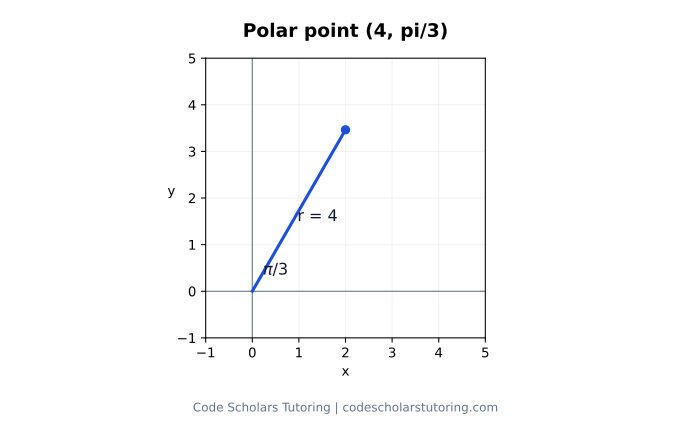
Convert the polar point (4,π/3)\displaystyle (4,\pi/3) to Cartesian coordinates.

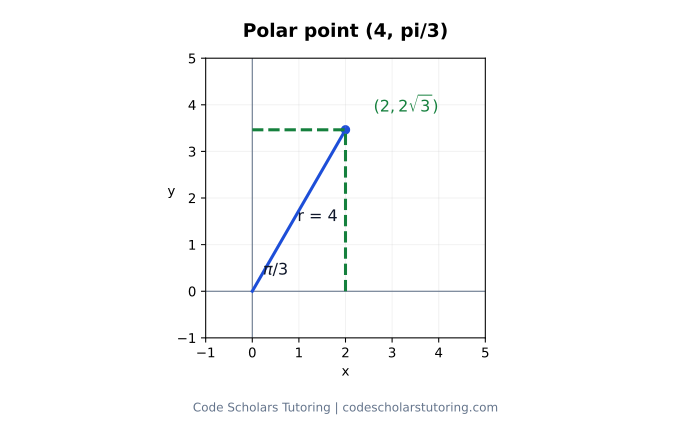
A radius of length 4 makes an angle pi/3 with the positive horizontal axis.
Use x = r cos(theta) and y = r sin(theta).
Show worked solution

x=4cos⁡(π/3)=2\displaystyle x=4\cos(\pi/3)=2 and y=4sin⁡(π/3)=23\displaystyle y=4\sin(\pi/3)=2\sqrt{3}.

A radius of length 4 makes an angle pi/3 with the positive horizontal axis. The solution adds labeled relationships.
Cartesian coordinates are (2, 2 sqrt(3)).

Problem 8.1.2

Give an equivalent representation of (3,π/4)\displaystyle (3,\pi/4) with negative radius.

Show worked solution

One answer is (−3,5π/4)\displaystyle (-3,5\pi/4).

Problem 8.1.3

Are (2,π/2)\displaystyle (2,\pi/2) and (−2,3π/2)\displaystyle (-2,3\pi/2) the same point?

Show worked solution

Yes. Both convert to (0,2)\displaystyle (0,2).

Need help with this topic?

Work through questions with a tutor and get help with the steps you find difficult.

Get help with this topic