Precalculus Honors · Study guide

6.2 · Continuity and the tangent-line preview of calculus

Use the limit definition of continuity, repair removable holes, and interpret a derivative as the limiting slope of secants.

Precalculus Honors · Reading: Demana 10th ed. §§11.1, 11.3–11.4; Stewart 8th ed. §§12.3–12.4

Learning objectives

  • Check the conditions for continuity at a point.
  • Distinguish continuity from differentiability.
  • Find a simple tangent slope from a difference quotient.

Continuity connects the limit and the actual value

A function is continuous at a\displaystyle a when f(a)\displaystyle f(a) is defined, its finite two-sided limit exists, and the limit equals f(a)\displaystyle f(a). Repairing a removable hole means assigning the existing limiting value at that input.

A jump or an infinite discontinuity cannot be repaired by changing only one point value. At an endpoint of a closed domain, continuity uses the one-sided limit from within the domain.

Secant slopes approach a tangent slope

The average rate of change from a\displaystyle a to a+h\displaystyle a+h is [f(a+h)−f(a)]/h\displaystyle [f(a+h)-f(a)]/h for nonzero h\displaystyle h. If these rates approach a finite common value from both directions, their limit is the derivative at a\displaystyle a.

For f(x)=x2\displaystyle f(x)=x^2, expanding and canceling gives the difference quotient 2a+h\displaystyle 2a+h, whose limit is 2a\displaystyle 2a. This is a preview of differentiation, not a reason to substitute h=0\displaystyle h=0 before simplifying.

f′(a)=lim⁡h→0f(a+h)−f(a)hf'(a)=\lim_{h\to0}\frac{f(a+h)-f(a)}{h}

A continuous corner can lack a tangent slope

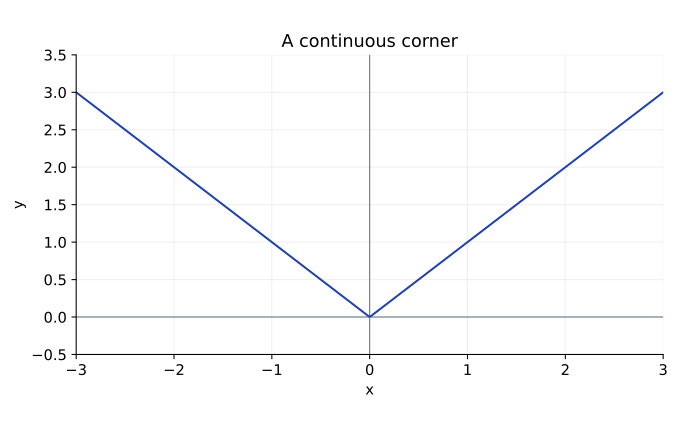
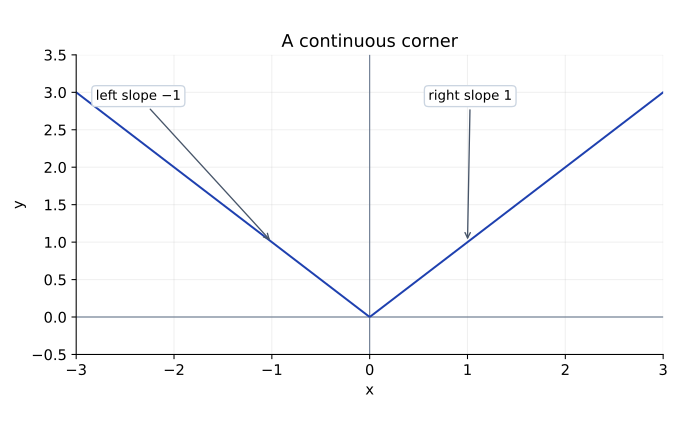
The function ∣x∣\displaystyle |x| is continuous at 0\displaystyle 0, but its left slopes are −1\displaystyle -1 and right slopes are 1\displaystyle 1. There is no finite two-sided derivative there.

Differentiability implies continuity; the converse fails. Use the graph to identify corners and breaks, then use one-sided slopes or limits to justify the conclusion.

Worked examples

Repair a hole

Let f(x)=(x2−1)/(x−1)\displaystyle f(x)=(x^2-1)/(x-1) for x≠1\displaystyle x\ne1 and f(1)=k\displaystyle f(1)=k. Find k for continuity.

  1. The nearby formula simplifies to x+1\displaystyle x+1.
  2. The limit at 1\displaystyle 1 is 2\displaystyle 2.
  3. Set k=2\displaystyle k=2 to match that limit.

A tangent from a limit

Find the tangent slope to x2\displaystyle x^2 at x=2\displaystyle x=2 using the definition.

  1. The quotient is [(2+h)2−4]/h\displaystyle [(2+h)^2-4]/h.
  2. For h≠0\displaystyle h\ne0 it simplifies to 4+h\displaystyle 4+h.
  3. The limiting slope is 4\displaystyle 4, giving tangent y−4=4(x−2)\displaystyle y-4=4(x-2).

Common mistakes

  • Claiming continuity guarantees differentiability.
  • Plugging h equals zero into an unsimplified quotient.
  • Trying to repair a jump by changing one point value.

Try it yourself

No calculator required.

1. Is f(x)=∣x∣\displaystyle f(x)=|x| continuous and differentiable at 0\displaystyle 0? Justify each claim.

The absolute-value graph has two straight branches meeting at the origin.
Compare both point continuity and one-sided slopes.
Show worked solution

It is continuous because both one-sided function limits equal f(0)=0\displaystyle f(0)=0. It is not differentiable because the one-sided slopes are −1\displaystyle -1 and 1\displaystyle 1.

The absolute-value graph has two straight branches meeting at the origin. The function is continuous at zero but has left slope minus 1 and right slope 1, so no derivative exists there.
The function is continuous at zero but has left slope minus 1 and right slope 1, so no derivative exists there.

2. For f(x)=(x2−1)/(x−1)\displaystyle f(x)=(x^2-1)/(x-1) away from 1\displaystyle 1, what value of f(1)\displaystyle f(1) gives continuity?

Show worked solution

The nearby expression is x+1\displaystyle x+1, whose limit at 1\displaystyle 1 is 2\displaystyle 2. Assign f(1)=2\displaystyle f(1)=2.

3. Use a difference quotient to find f′(2)\displaystyle f'(2) for f(x)=x2\displaystyle f(x)=x^2.

Show worked solution

The quotient simplifies to 4+h\displaystyle 4+h for nonzero h\displaystyle h. Its limit is 4\displaystyle 4. The tangent at (2,4)\displaystyle (2,4) is y=4x−4\displaystyle y=4x-4.

Need help with this topic?

Work through questions with a tutor and get help with the steps you find difficult.

Get help with this topic