
A removable limit
Evaluate .
- Factor .
- For , the quotient equals .
- The limit is .
Precalculus Honors · Study guide
Separate nearby behavior from a point value, compare one-sided limits, and resolve removable indeterminate forms.
Precalculus Honors · Reading: Demana 10th ed. §11.3; Stewart 8th ed. §§12.1–12.2
The statement concerns outputs near , with the input distinct from . A missing or different point value does not automatically prevent the limit.
Trace the graph toward the input from both sides. A filled dot tells you the defined point value; the nearby curve tells you the approached height.
A finite two-sided limit exists exactly when the left and right limits exist and agree. If the branches approach different heights, the two-sided limit does not exist regardless of the point value.
A finite table suggests a trend but does not prove behavior at every nearby input. Combine numerical evidence with a formula or a known graph whenever possible.
For near , substitution gives the indeterminate form . Factoring and canceling for yields , whose limit is .
The cancellation does not define the original expression at the excluded point. A limit can exist even when the original function is undefined there.
Evaluate .
The left-hand limit at is and the right-hand limit is . Does a two-sided limit exist?
No calculator required.
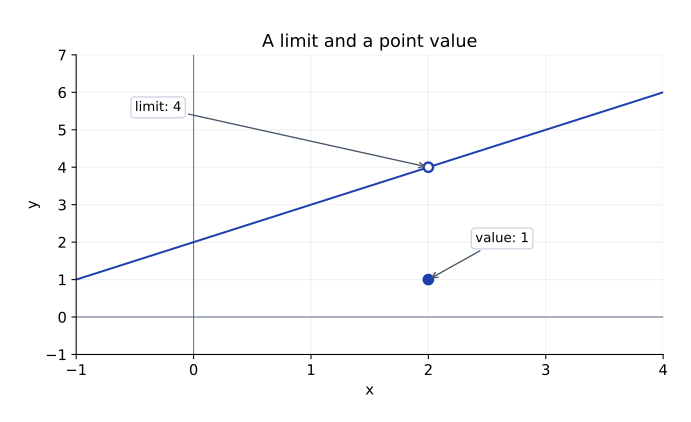
1. A graph follows except that . Find and .
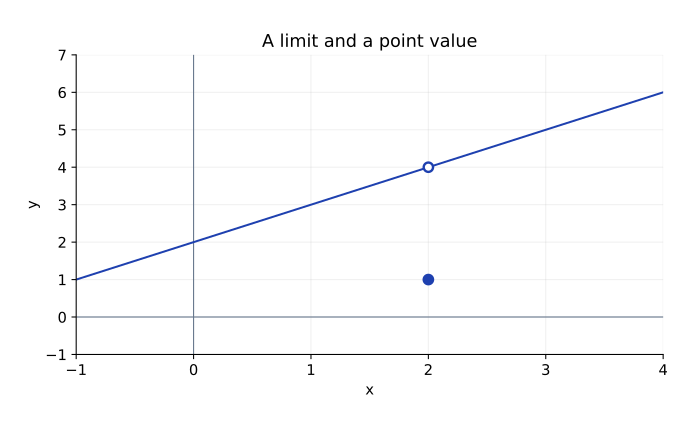
The nearby line approaches height from both sides, so the limit is . The filled point defines .
2. Evaluate .
For , factor and cancel to get . The limit is .
3. A table gives values near from the left of and near from the right. What does this suggest about the two-sided limit?
It suggests unequal one-sided limits and therefore no two-sided limit. A finite sample is evidence; exact justification needs the governing graph or formula.
Work through questions with a tutor and get help with the steps you find difficult.
Get help with this topic