AP Precalculus · Lesson 3.4

Phase Shift

How it works

Factor the coefficient of x before reading a horizontal shift. A positive h in the form x minus h shifts the graph right. The order matters: reading the constant before factoring usually gives the wrong shift.

y=Asin⁡(B(x−h))+Dy=A\sin(B(x-h))+D

Worked examples

Example 1

Find the shift in y=sin⁡(2x−π)\displaystyle y=\sin(2x-\pi).

Factor as sin⁡(2(x−π/2))\displaystyle \sin(2(x-\pi/2)). The shift is right π/2\displaystyle \pi/2.

Example 2

Find the shift in y=3cos⁡(x+π/4)\displaystyle y=3\cos(x+\pi/4).

Write x−(−π/4)\displaystyle x-(-\pi/4): the shift is left π/4\displaystyle \pi/4.

Problems

Problem 3.4.1

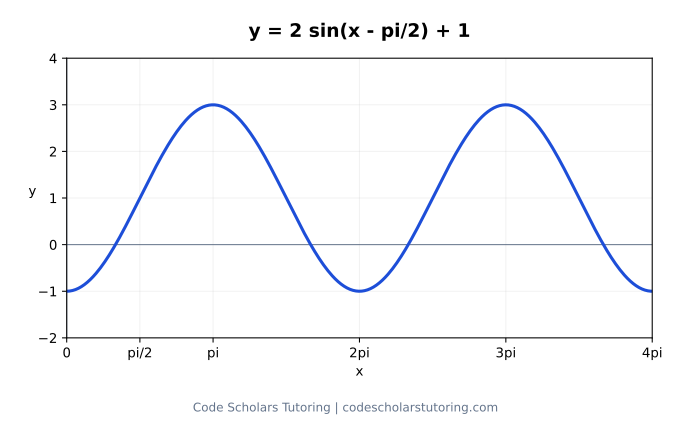
For y=2sin⁡(x−π/2)+1\displaystyle y=2\sin(x-\pi/2)+1, find the shift and the value at x=π/2\displaystyle x=\pi/2.

Sine curve shifted right pi/2, with amplitude 2 and midline 1.
The graph crosses its midline upward at x = pi/2.
Show worked solution

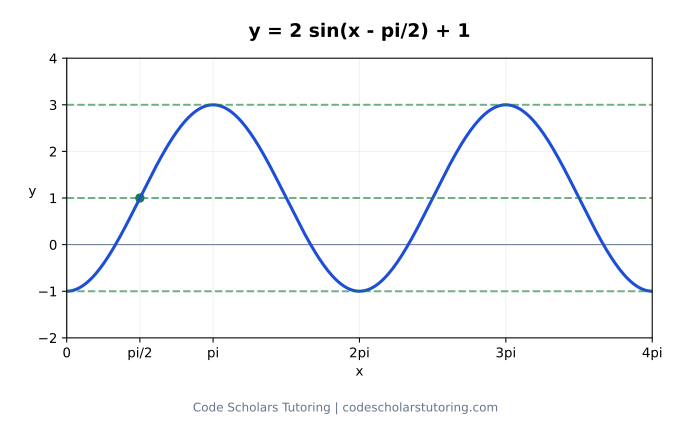
The shift is right π/2\displaystyle \pi/2. The value is 2sin⁡0+1=1\displaystyle 2\sin0+1=1.

Sine curve shifted right pi/2, with amplitude 2 and midline 1. The solution adds labeled relationships.
The highlighted midline crossing is (pi/2, 1).

Problem 3.4.2

Factor the argument and find the shift of y=cos⁡(3x+π)\displaystyle y=\cos(3x+\pi).

Show worked solution

It is cos⁡(3(x+π/3))\displaystyle \cos(3(x+\pi/3)), shifted left π/3\displaystyle \pi/3.

Problem 3.4.3

Write a sine function of amplitude 1\displaystyle 1, period 2π\displaystyle 2\pi, shifted right π/3\displaystyle \pi/3.

Show worked solution

One answer is y=sin⁡(x−π/3)\displaystyle y=\sin(x-\pi/3).

Need help with this topic?

Work through questions with a tutor and get help with the steps you find difficult.

Get help with this topic