AP Precalculus · Lesson 3.7

Polar Functions

How it works

In a polar function, radius changes with angle. Increasing radius means motion outward only when the radius is nonnegative; a negative radius places a point in the opposite direction. Evaluate signed radii and convert selected points before describing the curve.

r=f(θ),(x,y)=(f(θ)cos⁡θ,f(θ)sin⁡θ)r=f(\theta),\quad(x,y)=(f(\theta)\cos\theta,f(\theta)\sin\theta)

Worked examples

Example 1

For r=2cos⁡θ\displaystyle r=2\cos\theta, find the radius at θ=π/3\displaystyle \theta=\pi/3 and convert the point.

The radius is 1\displaystyle 1, giving Cartesian point (1/2,3/2)\displaystyle (1/2,\sqrt{3}/2).

Example 2

For r=1+cos⁡θ\displaystyle r=1+\cos\theta, find the radii at 0\displaystyle 0 and π\displaystyle \pi.

They are 2\displaystyle 2 and 0\displaystyle 0, so the curve reaches the pole at π\displaystyle \pi.

Problems

Problem 3.7.1

For r=2cos⁡θ\displaystyle r=2\cos\theta, find the radius and Cartesian point at θ=2π/3\displaystyle \theta=2\pi/3.

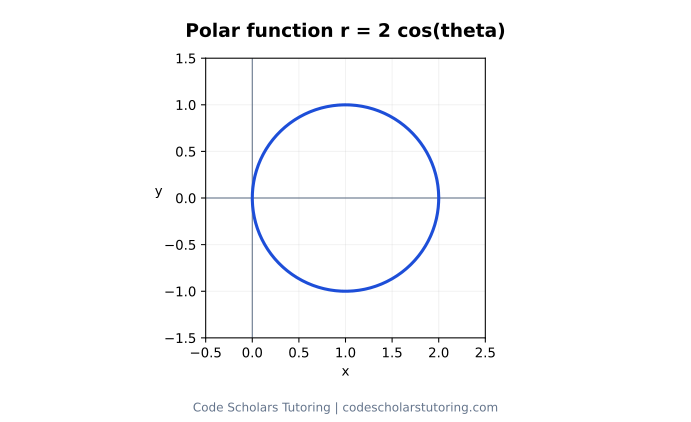
A circle centered at 1,0 with radius 1, passing through the pole and 2,0.
Signed radii trace a circle even when the radius is negative.
Show worked solution

The radius is −1\displaystyle -1. The Cartesian point is (1/2,−3/2)\displaystyle (1/2,-\sqrt{3}/2), opposite the ray of angle 2π/3\displaystyle 2\pi/3.

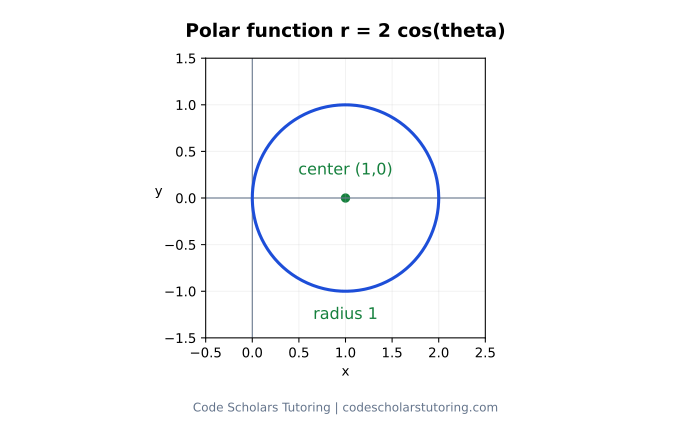
A circle centered at 1,0 with radius 1, passing through the pole and 2,0. The solution adds labeled relationships.
The Cartesian equation is (x - 1)^2 + y^2 = 1.

Problem 3.7.2

For r=3sin⁡θ\displaystyle r=3\sin\theta, find the point at θ=π/2\displaystyle \theta=\pi/2.

Show worked solution

The radius is 3\displaystyle 3, so the Cartesian point is (0,3)\displaystyle (0,3).

Problem 3.7.3

Convert r=2cos⁡θ\displaystyle r=2\cos\theta to a Cartesian circle equation.

Show worked solution

Multiply by r: x2+y2=2x\displaystyle x^2+y^2=2x, hence (x−1)2+y2=1\displaystyle (x-1)^2+y^2=1.

Need help with this topic?

Work through questions with a tutor and get help with the steps you find difficult.

Get help with this topic