AP Precalculus · Lesson 3.1

Periodic Phenomena

How it works

A periodic function repeats after a fixed positive input shift. The smallest positive repeat time, when it exists, is the fundamental period. A repeated output value alone is insufficient to establish a full repeat of the function.

f(t+T)=f(t)for every t in the repeating domainf(t+T)=f(t)\quad\text{for every }t\text{ in the repeating domain}

Worked examples

Example 1

A wheel completes a rotation in 30\displaystyle 30 seconds. What period does a seat-height model have?

The seat-height cycle repeats every 30\displaystyle 30 seconds.

Example 2

For f(t)=cos⁡(πt/4)\displaystyle f(t)=\cos(\pi t/4), find the fundamental period.

T=2π/(π/4)=8\displaystyle T=2\pi/(\pi/4)=8.

Problems

Problem 3.1.1

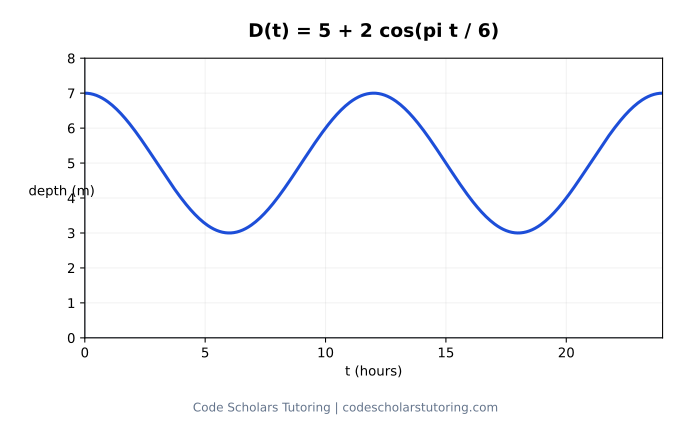
For D(t)=5+2cos⁡(πt/6)\displaystyle D(t)=5+2\cos(\pi t/6), find a repeat time and evaluate D(0),D(6),D(12)\displaystyle D(0),D(6),D(12).

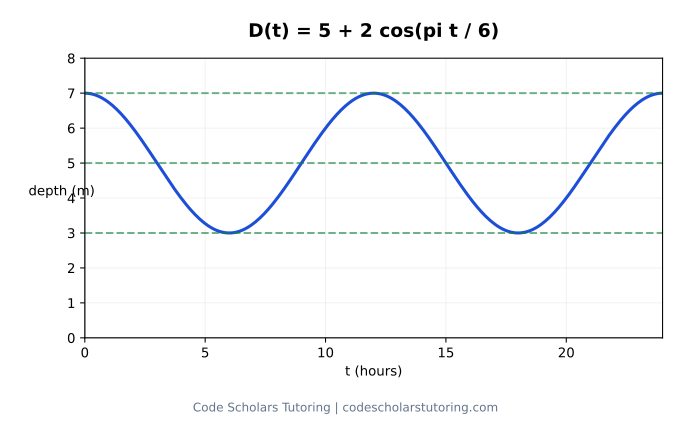
Depth oscillates between 3 and 7 meters over a 12-hour repeat time.
Time is in hours and depth in meters.
Show worked solution

The period is 12\displaystyle 12. The depths are 7,3,7\displaystyle 7,3,7 meters respectively.

Depth oscillates between 3 and 7 meters over a 12-hour repeat time. The solution adds labeled relationships.
Maximum depth = 7 m, minimum = 3 m, period = 12 h.

Problem 3.1.2

Does f(0)=f(2)\displaystyle f(0)=f(2) alone prove f has period 2\displaystyle 2?

Show worked solution

No. A period requires f(t+2)=f(t)\displaystyle f(t+2)=f(t) for every relevant t. For example, (t−1)2\displaystyle (t-1)^2 has equal values at 0\displaystyle 0 and 2\displaystyle 2 but is not periodic.

Problem 3.1.3

A signal repeats every 0.25\displaystyle 0.25 seconds. Find its frequency in cycles per second.

Show worked solution

Frequency is the reciprocal of period: 1/0.25=4\displaystyle 1/0.25=4 cycles per second.

Need help with this topic?

Work through questions with a tutor and get help with the steps you find difficult.

Get help with this topic