
Algebra 2 Honors · Lesson 5.1

Arithmetic and Geometric Sequences

How it works

An arithmetic sequence adds a fixed difference from one term to the next. A geometric sequence multiplies by a fixed ratio. For a nonzero geometric starting term, ratios between successive terms reveal the pattern; differences reveal arithmetic patterns. Sequence inputs are discrete integer positions.

an=a1+(n−1)d,an=a1rn−1a_n=a_1+(n-1)d,\qquad a_n=a_1r^{n-1}

Worked examples

Example 1

Find term 6\displaystyle 6 of 4,7,10,…\displaystyle 4,7,10,\ldots.

The difference is 3\displaystyle 3. Thus a6=4+5(3)=19\displaystyle a_6=4+5(3)=19.

Example 2

Find term 5\displaystyle 5 of 3,6,12,…\displaystyle 3,6,12,\ldots.

The ratio is 2\displaystyle 2. Thus a5=3⋅24=48\displaystyle a_5=3\cdot2^4=48.

Problems

Problem 5.1.1

Find term 8\displaystyle 8 of 10,7,4,…\displaystyle 10,7,4,\ldots.

Show worked solution

The difference is −3\displaystyle -3, so a8=10+7(−3)=−11\displaystyle a_8=10+7(-3)=-11.

Problem 5.1.2

Find term 4\displaystyle 4 of 81,27,9,…\displaystyle 81,27,9,\ldots.

Show worked solution

The ratio is 1/3\displaystyle 1/3. Thus a4=81(1/3)3=3\displaystyle a_4=81(1/3)^3=3.

Problem 5.1.3

The graph shows terms of an=2⋅3n−1\displaystyle a_n=2\cdot3^{n-1}. Give its first four terms and explain why the graph uses separate points.
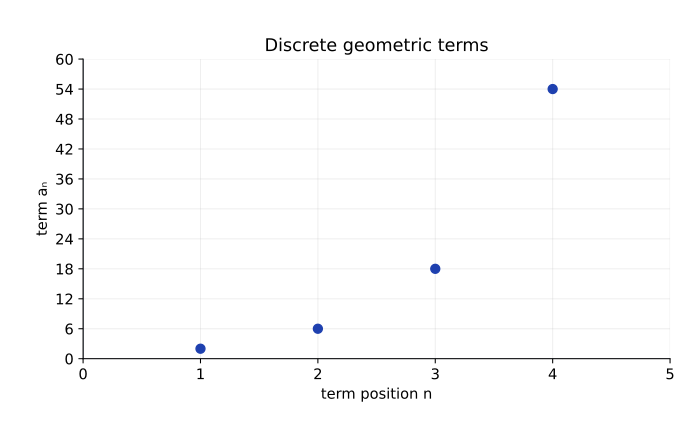
Four separate points represent 2, 6, 18, and 54 at sequence positions 1 through 4.
A sequence has integer positions rather than a continuous input interval.
Show worked solution

The terms are 2,6,18,54\displaystyle 2,6,18,54. Only integer positions n=1,2,3,…\displaystyle n=1,2,3,\ldots belong to the sequence, so the graph is discrete.
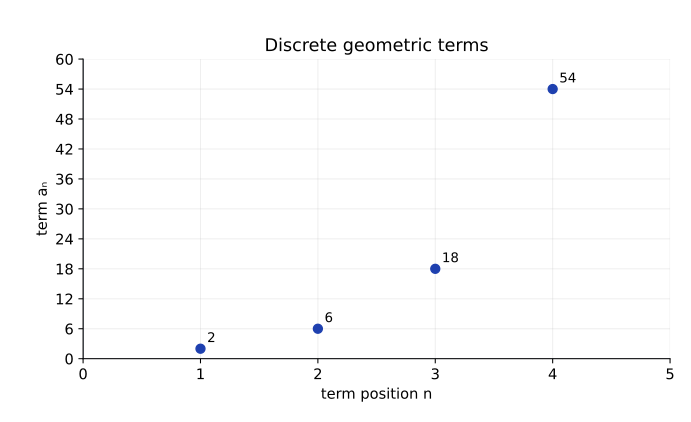
Four separate points represent 2, 6, 18, and 54 at sequence positions 1 through 4. The common ratio is 3; the first four terms are 2, 6, 18, 54.
The common ratio is 3; the first four terms are 2, 6, 18, 54.

Need help with this topic?

Work through questions with a tutor and get help with the steps you find difficult.

Get help with this topic