Algebra 2 Honors · Lesson 5.3

Series and Convergence

How it works

A series adds sequence terms. Finite arithmetic and geometric sums have different formulas. An infinite geometric series has a finite sum only when the common ratio has absolute value less than 1; in that case its terms approach zero fast enough for the partial sums to settle.

Sn=n(a1+an)2,S∞=a11−r(∣r∣<1)S_n=\frac{n(a_1+a_n)}2,\qquad S_\infty=\frac{a_1}{1-r}\quad(|r|<1)

Worked examples

Example 1

Find 1+2+⋯+20\displaystyle 1+2+\cdots+20.

Use the arithmetic sum: S20=20(1+20)/2=210\displaystyle S_{20}=20(1+20)/2=210.

Example 2

Find the infinite sum 6+3+3/2+⋯\displaystyle 6+3+3/2+\cdots.

The ratio is 1/2\displaystyle 1/2, whose absolute value is below 1\displaystyle 1. Thus S=6/(1−1/2)=12\displaystyle S=6/(1-1/2)=12.

Problems

Problem 5.3.1

Find the sum of the first 10\displaystyle 10 terms of 3,5,7,…\displaystyle 3,5,7,\ldots.

Show worked solution

The tenth term is 3+9(2)=21\displaystyle 3+9(2)=21. Thus S10=10(3+21)/2=120\displaystyle S_{10}=10(3+21)/2=120.

Problem 5.3.2

Does 1+2+4+8+⋯\displaystyle 1+2+4+8+\cdots have a finite sum?

Show worked solution

No. The ratio is 2\displaystyle 2, so ∣r∣≥1\displaystyle |r|\ge1 and the infinite geometric series diverges.

Problem 5.3.3

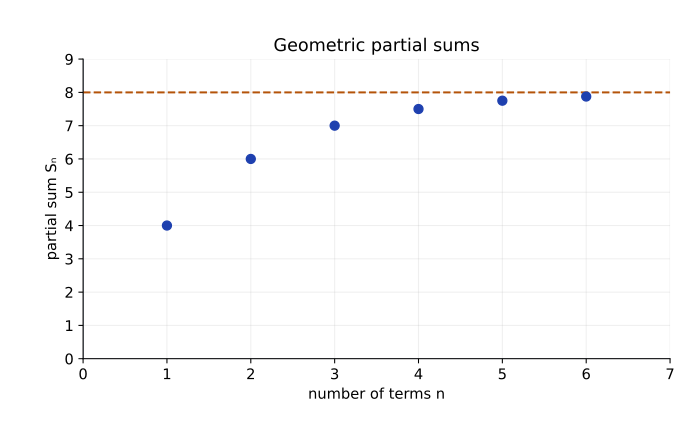
The graph shows partial sums of 4+2+1+⋯\displaystyle 4+2+1+\cdots. Find the limiting sum.

The first six partial sums of 4 + 2 + 1 + ... approach the dashed height 8.
The points are partial sums, not the individual series terms.
Show worked solution

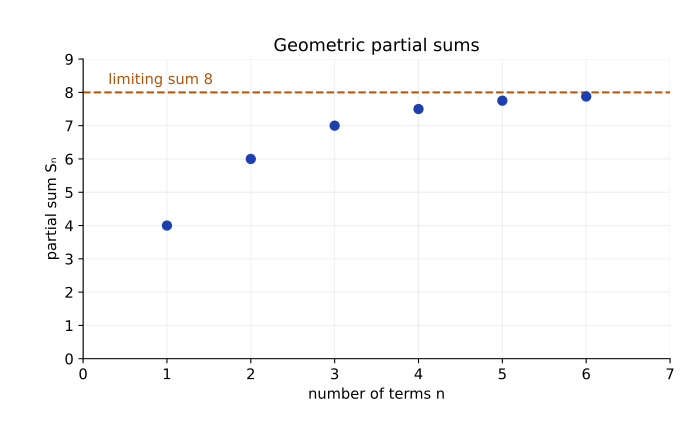
The ratio is 1/2\displaystyle 1/2, so the infinite sum is 4/(1−1/2)=8\displaystyle 4/(1-1/2)=8. The plotted partial sums approach 8\displaystyle 8.

The first six partial sums of 4 + 2 + 1 + ... approach the dashed height 8. The infinite geometric sum is 8.
The infinite geometric sum is 8.

Need help with this topic?

Work through questions with a tutor and get help with the steps you find difficult.

Get help with this topic