Calculus Honors · AP-aligned study guide

6.4 · Improper integrals and convergence

Replace infinite bounds and singular endpoints with limits, test convergence, and reject cancellation across a divergent singularity.

BC extension · Optional for AP Calculus AB

BC extension: AP 6.13 · Reading: Larson & Edwards §8.8

Learning objectives

  • Define an improper integral with a limit.
  • Determine convergence of a power-tail integral.
  • Split an integral at an interior singularity.

An infinite bound is a limiting process

Define ∫a∞f(x)dx\displaystyle \int_a^\infty f(x)dx as lim⁡b→∞∫abf(x)dx\displaystyle \lim_{b\to\infty}\int_a^b f(x)dx. The integral converges only if this limit is finite. Evaluate the finite-bound integral first, then take the limit.

For ∫1∞x−2dx\displaystyle \int_1^\infty x^{-2}dx, the finite integral is 1−1/b\displaystyle 1-1/b, which tends to 1\displaystyle 1. An unbounded interval can enclose finite area.

∫a∞f(x) dx=lim⁡b→∞∫abf(x) dx\int_a^{\infty}f(x)\,dx=\lim_{b\to\infty}\int_a^b f(x)\,dx

A singular endpoint also requires a limit

For an integrand unbounded at the left endpoint, replace that endpoint by a variable approaching from inside the interval. The integral ∫01x−1/2dx\displaystyle \int_0^1x^{-1/2}dx becomes a right-hand endpoint limit and converges to 2\displaystyle 2.

For an interior singularity, split the integral into two improper integrals. Both must converge separately. Opposite infinite contributions do not cancel in the ordinary improper-integral definition.

Distinguish the two power tests

The tail ∫1∞x−pdx\displaystyle \int_1^\infty x^{-p}dx converges exactly when p>1\displaystyle p>1. The near-zero integral ∫01x−pdx\displaystyle \int_0^1x^{-p}dx converges exactly when p<1\displaystyle p<1. At p=1\displaystyle p=1, logarithmic divergence occurs in both cases.

Do not transfer the tail test unchanged to a finite singular endpoint. Locate the source of impropriety before deciding which limit and comparison apply.

Worked examples

A convergent tail

Evaluate ∫1∞x−2dx\displaystyle \int_1^\infty x^{-2}dx.

  1. Integrate to a finite upper bound: [−1/x]1b=1−1/b\displaystyle [-1/x]_1^b=1-1/b.
  2. Take b→∞\displaystyle b\to\infty.
  3. The limit is 1\displaystyle 1, so the integral converges.

A divergent tail

Determine whether ∫1∞1/x dx\displaystyle \int_1^\infty1/x\,dx converges.

  1. The finite integral is ln⁡b\displaystyle \ln b.
  2. As b→∞\displaystyle b\to\infty, this grows without bound.
  3. The improper integral diverges; it has no finite value.

Common mistakes

  • Substituting infinity as if it were a finite bound.
  • Using a tail convergence condition at a singular finite endpoint.
  • Canceling divergent contributions across a singularity.

Try it yourself

No calculator required.

1. Evaluate ∫1∞x−3 dx\displaystyle \int_1^\infty x^{-3}\,dx using a limit.

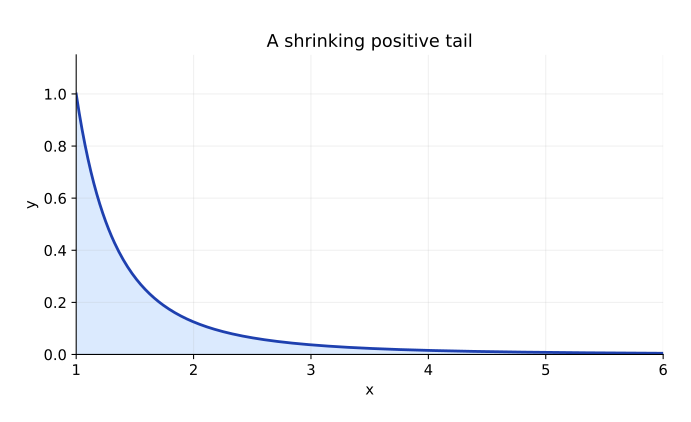
The graph y = x to the minus third power for x at least 1, extending to the right.
The graph continues beyond the plotted window; evaluate a limit to test its area.
Show worked solution

The finite integral is [−1/(2x2)]1b=1/2−1/(2b2)\displaystyle [-1/(2x^2)]_1^b=1/2-1/(2b^2). Its limit is 1/2\displaystyle 1/2, so the integral converges.

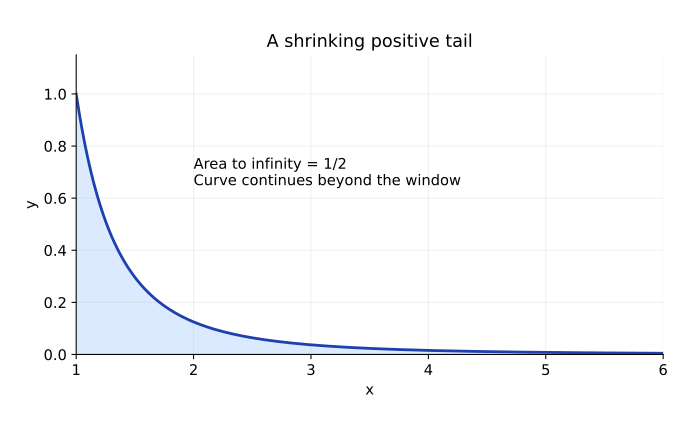
The graph y = x to the minus third power for x at least 1, extending to the right. The total area from 1 to infinity converges to one half; the remaining tail shrinks as the upper bound increases.
The total area from 1 to infinity converges to one half; the remaining tail shrinks as the upper bound increases.

2. Determine whether ∫01x−1/2 dx\displaystyle \int_0^1x^{-1/2}\,dx converges and find its value if it does.

Show worked solution

Use lim⁡a→0+∫a1x−1/2dx=lim⁡a→0+(2−2a)=2\displaystyle \lim_{a\to0^+}\int_a^1x^{-1/2}dx=\lim_{a\to0^+}(2-2\sqrt{a})=2. It converges.

3. Does ∫−11(1/x) dx\displaystyle \int_{-1}^1(1/x)\,dx equal zero?

Show worked solution

No. Split at 0\displaystyle 0. The left improper integral diverges to negative infinity and the right to positive infinity. Since neither converges, the ordinary improper integral diverges; symmetric cancellation is not its definition.

Need help with this topic?

Work through questions with a tutor and get help with the steps you find difficult.

Get help with this topic