
Calculus Honors · AP-aligned study guide

6.1 · Differential equations, slope fields, and Euler’s method

Interpret a differential equation as local slope information, verify solutions, and approximate a solution through successive tangent steps.

AP 7.1–7.4; Euler method: BC 7.5 · Reading: Larson & Edwards §6.1

Learning objectives

  • Read and construct slope-field segments from a differential equation.
  • Verify a proposed solution by substitution.
  • Apply Euler’s method using the previous step’s slope.

A differential equation specifies a rate

An equation y′=F(x,y)\displaystyle y'=F(x,y) assigns a slope to each allowed point. A slope field places short line segments with those slopes; a solution curve follows the local directions. An initial condition selects a curve through a specified point.

For y′=y\displaystyle y'=y, slopes depend on height alone: zero along y=0\displaystyle y=0, positive above, and negative below. For y′=x−y\displaystyle y'=x-y, zero slopes occur on y=x\displaystyle y=x.

Verify rather than guess a solution

To verify y=Cex\displaystyle y=Ce^x solves y′=y\displaystyle y'=y, differentiate the proposed formula and compare with the right side. Also check any initial condition separately.

A slope field suggests the shape but does not supply an exact formula. A proposed curve must satisfy the differential equation throughout its stated interval, not just at the initial point.

Euler’s method follows short tangent steps

Start at (xn,yn)\displaystyle (x_n,y_n), evaluate the slope there, then use yn+1=yn+hF(xn,yn)\displaystyle y_{n+1}=y_n+hF(x_n,y_n) and xn+1=xn+h\displaystyle x_{n+1}=x_n+h. Recompute the slope at every new point. Euler’s method is a BC extension in the AP framework.

Smaller steps usually improve a numerical approximation for a smooth well-behaved solution, but they do not turn it into an exact value. Clearly label the step size and the requested endpoint.

yn+1=yn+hF(xn,yn)y_{n+1}=y_n+hF(x_n,y_n)

Worked examples

Verify a formula

Check whether y=3ex\displaystyle y=3e^x solves y′=y\displaystyle y'=y, y(0)=3\displaystyle y(0)=3.

  1. Differentiation gives y′=3ex=y\displaystyle y'=3e^x=y.
  2. At 0\displaystyle 0, the function value is 3\displaystyle 3.
  3. Both the equation and initial condition hold.

Two Euler steps

Approximate y(1)\displaystyle y(1) for y′=y\displaystyle y'=y, y(0)=1\displaystyle y(0)=1, using h=1/2\displaystyle h=1/2.

  1. The first slope is 1\displaystyle 1, so y1=1+(1/2)1=3/2\displaystyle y_1=1+(1/2)1=3/2.
  2. The second slope is 3/2\displaystyle 3/2, so y2=3/2+(1/2)(3/2)=9/4\displaystyle y_2=3/2+(1/2)(3/2)=9/4.
  3. The approximation is y(1)≈9/4\displaystyle y(1)\approx9/4.

Common mistakes

  • Using the initial slope for every Euler step.
  • Treating a numerical approximation as an exact solution.
  • Checking an initial value but not the differential equation.

Try it yourself

No calculator required.

1. For y′=x−y\displaystyle y'=x-y, identify zero, positive, and negative slopes.
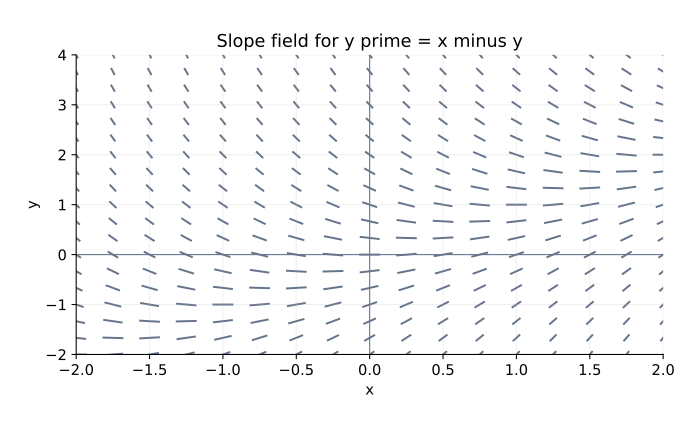
Slope segments are horizontal on y = x, positive below that line, and negative above it.
Compare segment directions above and below the diagonal.
Show worked solution

Slopes are zero on y=x\displaystyle y=x, positive below that line where x−y>0\displaystyle x-y>0, and negative above it. A solution curve must follow these directions.
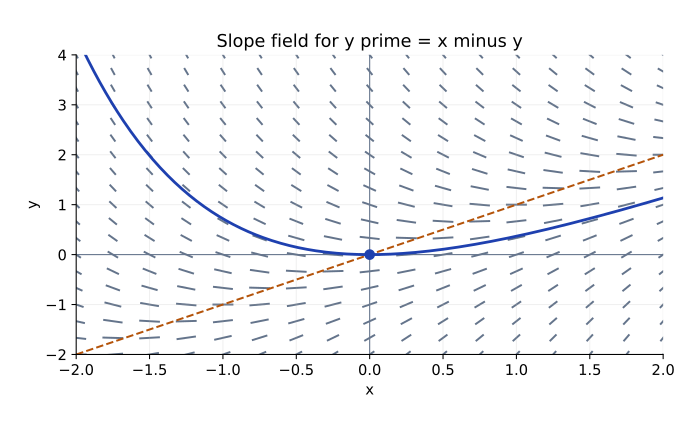
Slope segments are horizontal on y = x, positive below that line, and negative above it. The dashed diagonal has zero slopes; the blue example solution follows the field through (0, 0).
The dashed diagonal has zero slopes; the blue example solution follows the field through (0, 0).

BC extension

2. Use two Euler steps of h=1/2\displaystyle h=1/2 for y′=x+y\displaystyle y'=x+y, y(0)=1\displaystyle y(0)=1, to estimate y(1)\displaystyle y(1).

Show worked solution

At (0,1)\displaystyle (0,1) the slope is 1\displaystyle 1, so y1=3/2\displaystyle y_1=3/2. At (1/2,3/2)\displaystyle (1/2,3/2) the slope is 2\displaystyle 2, so y2=5/2\displaystyle y_2=5/2. Thus y(1)≈5/2\displaystyle y(1)\approx5/2.

3. Verify y=2e−x\displaystyle y=2e^{-x} as a solution of y′=−y\displaystyle y'=-y, y(0)=2\displaystyle y(0)=2.

Show worked solution

The derivative is −2e−x=−y\displaystyle -2e^{-x}=-y and the initial value is 2\displaystyle 2, so both conditions are satisfied.

Need help with this topic?

Work through questions with a tutor and get help with the steps you find difficult.

Get help with this topic