Geometry Honors · Lesson 6.1

Rigid Motions

How it works

Translations, rotations, and reflections preserve distances and angle measures. They produce congruent figures. Coordinate rules must specify the center or axis; a standard origin rule does not apply to an arbitrary center.

R90∘(x,y)=(−y,x),Fy-axis(x,y)=(−x,y)R_{90^\circ}(x,y)=(-y,x),\quad F_{y\text{-axis}}(x,y)=(-x,y)

Worked examples

Example 1

Rotate (3,1)\displaystyle (3,1) by 90∘\displaystyle 90^\circ counterclockwise about the origin.

Apply (x,y)↦(−y,x)\displaystyle (x,y)\mapsto(-y,x) to obtain (−1,3)\displaystyle (-1,3).

Example 2

Reflect (−2,5)\displaystyle (-2,5) across the x\displaystyle x-axis.

The horizontal coordinate stays fixed and the vertical coordinate changes sign: (−2,−5)\displaystyle (-2,-5).

Problems

Problem 6.1.1

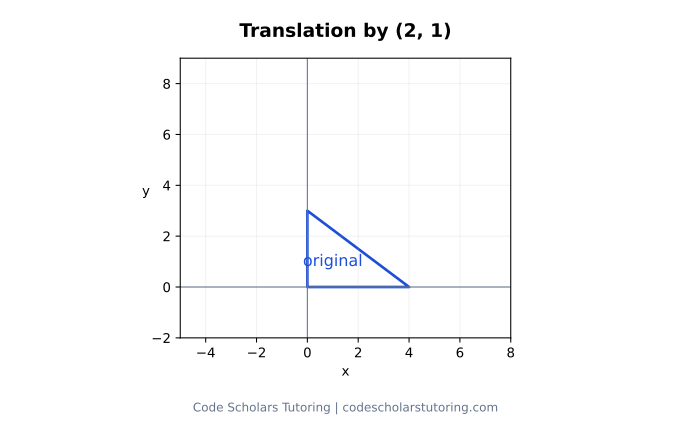
Translate A=(0,0)\displaystyle A=(0,0), B=(4,0)\displaystyle B=(4,0), C=(0,3)\displaystyle C=(0,3) by (2,1)\displaystyle (2,1).

Triangle with vertices 0,0; 4,0; 0,3. The solution shows its translate by 2,1.
Add the translation vector to every vertex.
Show worked solution

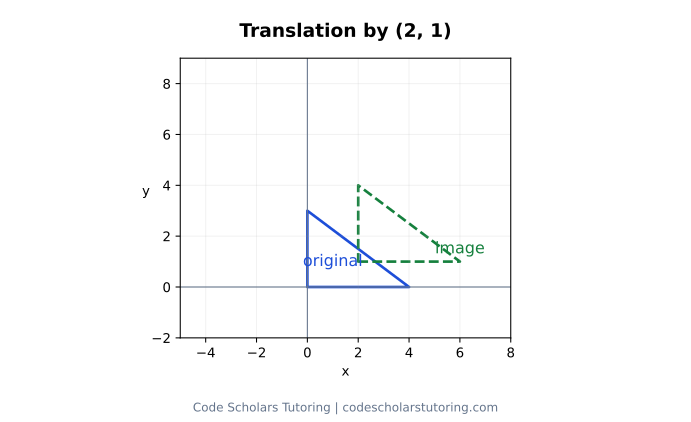
The image vertices are A′=(2,1)\displaystyle A\prime=(2,1), B′=(6,1)\displaystyle B\prime=(6,1), and C′=(2,4)\displaystyle C\prime=(2,4). All side lengths are preserved.

Triangle with vertices 0,0; 4,0; 0,3. The solution shows its translate by 2,1. The solution adds labeled relationships.
The image vertices are (2,1), (6,1), and (2,4).

Problem 6.1.2

Rotate (2,−4)\displaystyle (2,-4) by 180∘\displaystyle 180^\circ about the origin.

Show worked solution

Negate both coordinates: (−2,4)\displaystyle (-2,4).

Problem 6.1.3

Reflect (4,1)\displaystyle (4,1) across y=x\displaystyle y=x.

Show worked solution

Interchange coordinates to obtain (1,4)\displaystyle (1,4).

Need help with this topic?

Work through questions with a tutor and get help with the steps you find difficult.

Get help with this topic