Geometry Honors · Lesson 6.2

Dilations

How it works

A dilation multiplies displacement from its center by a scale factor. Positive factors preserve the direction from the center. Lengths scale by the factor, while areas scale by its square. Factors other than one generally change size.

P′=C+k(P−C),k>0P\prime=C+k(P-C),\quad k>0

Worked examples

Example 1

Dilate (3,−2)\displaystyle (3,-2) about the origin by factor 2\displaystyle 2.

The image is (6,−4)\displaystyle (6,-4).

Example 2

Dilate (5,3)\displaystyle (5,3) about C=(1,1)\displaystyle C=(1,1) by factor 1/2\displaystyle 1/2.

The displacement is (4,2)\displaystyle (4,2). Half is (2,1)\displaystyle (2,1), so the image is (3,2)\displaystyle (3,2).

Problems

Problem 6.2.1

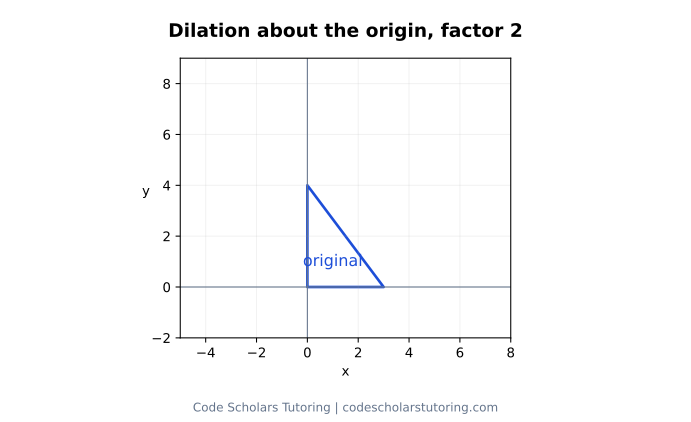
Dilate the triangle (0,0),(3,0),(0,4)\displaystyle (0,0),(3,0),(0,4) about the origin by factor 2\displaystyle 2. Give its image and area.

Triangle with vertices 0,0; 3,0; 0,4. The solution shows its factor-2 image.
Multiply each coordinate by 2.
Show worked solution

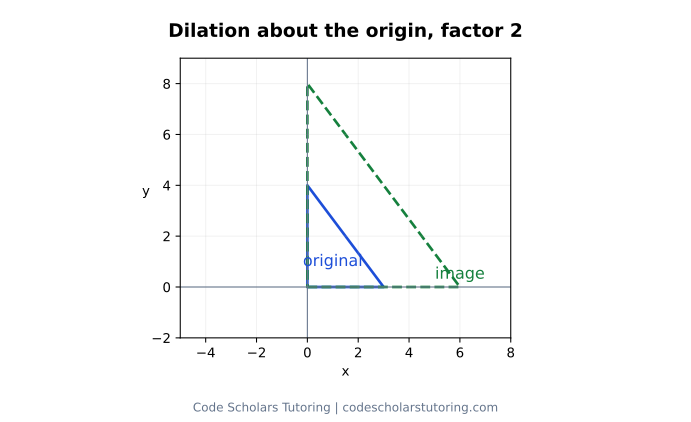
The image is (0,0),(6,0),(0,8)\displaystyle (0,0),(6,0),(0,8). Its area is 24\displaystyle 24, four times the original area 6\displaystyle 6.

Triangle with vertices 0,0; 3,0; 0,4. The solution shows its factor-2 image. The solution adds labeled relationships.
The image is (0,0), (6,0), (0,8), with area 24.

Problem 6.2.2

A dilation changes a length from 8\displaystyle 8 to 12\displaystyle 12. Find the scale factor and area factor.

Show worked solution

k=12/8=3/2\displaystyle k=12/8=3/2. The area factor is (3/2)2=9/4\displaystyle (3/2)^2=9/4.

Problem 6.2.3

Can a dilation by factor 3\displaystyle 3 be a rigid motion for a nondegenerate triangle?

Show worked solution

No. Its nonzero side lengths triple, so distances are not preserved.

Need help with this topic?

Work through questions with a tutor and get help with the steps you find difficult.

Get help with this topic