Additional course content; not assessed on the AP Precalculus Exam.

AP Precalculus · Lesson 4.3

Vectors

How it works

A vector records magnitude and direction. Add components to combine displacements; multiply all components to scale. A position vector and a point may use the same coordinate pair, but they represent different objects.

u+v=(u1+v1,u2+v2),∥v∥=v12+v22\mathbf{u}+\mathbf{v}=(u_1+v_1,u_2+v_2),\quad\|\mathbf{v}\|=\sqrt{v_1^2+v_2^2}

Worked examples

Example 1

Find the vector from A=(1,2)\displaystyle A=(1,2) to B=(4,6)\displaystyle B=(4,6) and its magnitude.

Subtract coordinates: AB→=(3,4)\displaystyle \overrightarrow{AB}=(3,4), whose magnitude is 5\displaystyle 5.

Example 2

For u=(2,−1)\displaystyle \mathbf{u}=(2,-1) and v=(3,4)\displaystyle \mathbf{v}=(3,4), find 2u+v\displaystyle 2\mathbf{u}+\mathbf{v}.

The result is (4,−2)+(3,4)=(7,2)\displaystyle (4,-2)+(3,4)=(7,2).

Problems

Problem 4.3.1

A displacement is u=(3,1)\displaystyle \mathbf{u}=(3,1) followed by v=(1,2)\displaystyle \mathbf{v}=(1,2). Find the resultant and its magnitude.
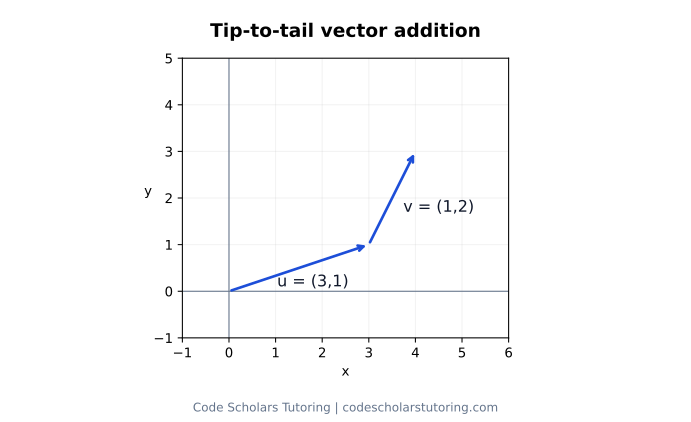
Vector 3,1 from the origin followed by vector 1,2 from its tip.
Place the second vector at the tip of the first.
Show worked solution

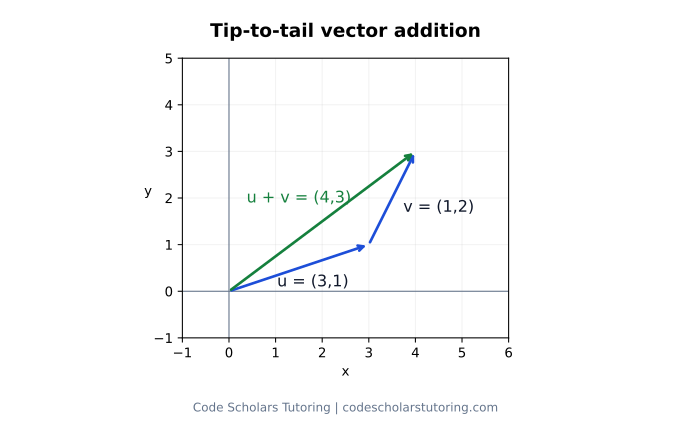
The resultant is (4,3)\displaystyle (4,3) with magnitude 5\displaystyle 5.

Vector 3,1 from the origin followed by vector 1,2 from its tip. The solution adds labeled relationships.
The resultant from the origin is (4,3), with magnitude 5.

Problem 4.3.2

Find a unit vector in the direction (6,8)\displaystyle (6,8).

Show worked solution

Its magnitude is 10\displaystyle 10, so a unit vector is (3/5,4/5)\displaystyle (3/5,4/5).

Problem 4.3.3

Compute (2,1)⋅(−1,2)\displaystyle (2,1)\cdot(-1,2) and interpret the result.

Show worked solution

The dot product is −2+2=0\displaystyle -2+2=0, so the nonzero vectors are perpendicular.

Need help with this topic?

Work through questions with a tutor and get help with the steps you find difficult.

Get help with this topic