
A square-root estimate
Estimate using a tangent at .
- At , the function value is and the derivative is .
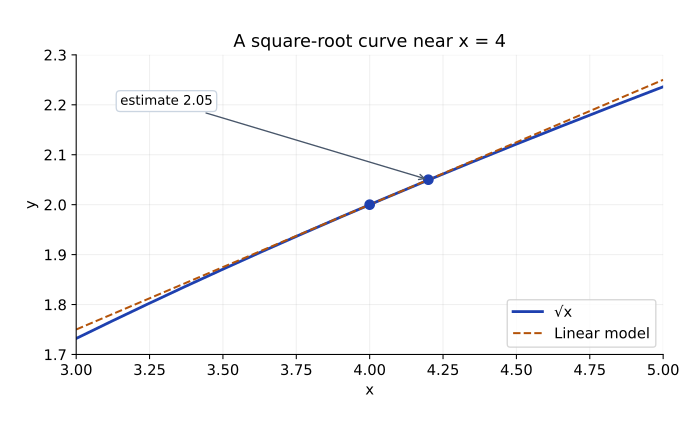
- The linear model gives .
- The square-root graph is concave down, so the estimate is above the true value.
Calculus Honors · AP-aligned study guide
Use tangent lines for local estimates, distinguish approximation error from concavity, and resolve eligible indeterminate limits.
AP 4.6–4.7 · Reading: Larson & Edwards §3.9; §8.7
Near , replace by its tangent-line model . Choose a nearby input where values and derivatives are easy to evaluate.
For near , . The estimate at is . This is an approximation, so use an approximation symbol when reporting the function value.
Where a graph is concave down throughout the interval between and the target, the tangent lies above the curve, giving an overestimate. Concave up gives an underestimate.
The differential estimates the actual change ; they are not generally identical. Estimates tend to improve as the target approaches the expansion input.
L’Hôpital’s Rule applies to eligible or quotients under differentiability and derivative-limit conditions. For , both numerator and denominator approach zero, and the derivative quotient tends to .
The rule uses the quotient of the separate derivatives, not the quotient rule. For a product or difference, first rewrite into an eligible quotient if possible. If substitution already gives a finite ordinary quotient, do not replace it by derivatives.
In an interval near the target, the numerator and denominator must be differentiable, with the denominator derivative nonzero. The quotient of derivatives must have the required finite or infinite limit. Check these conditions before replacing the quotient; use the matching one-sided version if approaching an endpoint.
Estimate using a tangent at .
Evaluate with L’Hôpital’s Rule.
No calculator required.
1. Use the tangent at to estimate . Is it above or below the actual value?
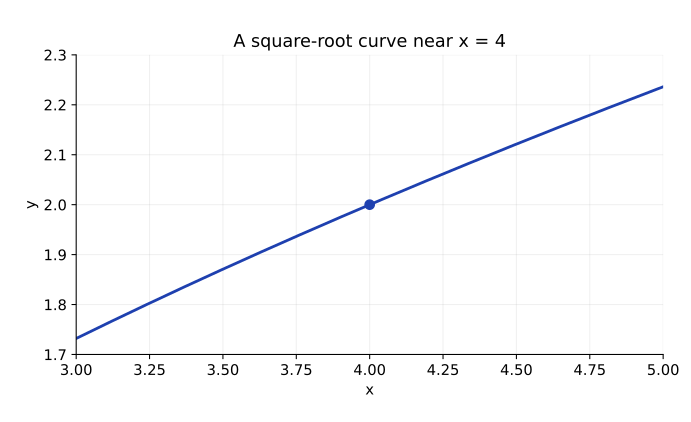
The model is , giving . The function is concave down on the interval, so this is an overestimate.
2. Evaluate . State the initial form.
The form is . L’Hôpital gives the derivative quotient , whose limit is .
3. Can L’Hôpital’s Rule evaluate by replacing numerator and denominator with derivatives?
No: the initial quotient is , not an indeterminate form. Direct substitution gives . The derivative quotient would give , showing why the hypotheses matter.
Work through questions with a tutor and get help with the steps you find difficult.
Get help with this topic