Calculus Honors · AP-aligned study guide

3.1 · Motion, units, and related rates

Translate changing quantities into derivative equations, distinguish speed from velocity, and preserve units.

AP 4.1–4.5 · Reading: Larson & Edwards §§2.6, 3.9

Learning objectives

  • Set up and solve a related-rates equation.
  • Use velocity and acceleration signs to describe motion.
  • Interpret derivative units in a context.

Velocity, speed, and acceleration

Position s(t)\displaystyle s(t) differentiates to velocity v(t)\displaystyle v(t), and velocity differentiates to acceleration a(t)\displaystyle a(t). Speed is ∣v(t)∣\displaystyle |v(t)|, so negative velocity describes direction rather than negative speed.

When v\displaystyle v and a\displaystyle a have the same sign, speed increases. When their signs differ, speed decreases. At an instant with either value zero, inspect nearby signs before describing an interval of motion.

Differentiate before substituting the snapshot

For a changing circle, A=πr2\displaystyle A=\pi r^2 relates area and radius at every time. Differentiate this relationship with respect to time to obtain dAdt=2πr drdt\displaystyle \frac{dA}{dt}=2\pi r\,\frac{dr}{dt}. Substitute the current radius only after differentiating.

Draw and label the geometry first. A fixed length differentiates to zero; a changing length needs a time derivative. Convert units before combining quantities, and state what sign your final rate represents.

dAdt=2πrdrdt\frac{dA}{dt}=2\pi r\frac{dr}{dt}

Choose the relationship that links the unknowns

For a right triangle with changing legs, begin with x2+y2=L2\displaystyle x^2+y^2=L^2. If L\displaystyle L is fixed, differentiation gives 2x dxdt+2y dydt=0\displaystyle 2x\,\frac{dx}{dt}+2y\,\frac{dy}{dt}=0. Use the geometry to find any missing length at the requested instant.

A rate equation is local: it describes the specific snapshot after all variables are evaluated. A negative height rate means the height is decreasing, not that the height itself is negative.

Worked examples

Expanding circle

A circle has r=3\displaystyle r=3 cm and drdt=2\displaystyle \frac{dr}{dt}=2 cm/s. Find its area rate.

  1. Use A=πr2\displaystyle A=\pi r^2.
  2. Differentiate to get dAdt=2πr drdt\displaystyle \frac{dA}{dt}=2\pi r\,\frac{dr}{dt}.
  3. The result is 12π\displaystyle 12\pi square centimeters per second.

Speeding up or slowing down

At an instant, v=−3\displaystyle v=-3 and a=2\displaystyle a=2. Is the object speeding up?

  1. The object moves in the negative direction.
  2. The positive acceleration opposes the negative velocity.
  3. Its speed is decreasing at this instant.

Common mistakes

  • Substituting a changing length as a constant before differentiating.
  • Treating negative velocity as negative speed.
  • Leaving out time-derivative factors or units.

Try it yourself

No calculator required.

1. A sphere has V=43πr3\displaystyle V=\frac{4}{3}\pi r^3. If r=2\displaystyle r=2 cm and drdt=3\displaystyle \frac{dr}{dt}=3 cm/s, find dVdt\displaystyle \frac{dV}{dt}.

Show worked solution

Differentiate to obtain dVdt=4πr2 drdt\displaystyle \frac{dV}{dt}=4\pi r^2\,\frac{dr}{dt}. At the specified instant the rate is 48π\displaystyle 48\pi cubic centimeters per second.

2. A 5 m ladder has base distance x=3\displaystyle x=3 m increasing at dxdt=2\displaystyle \frac{dx}{dt}=2 m/s. Find the height rate.

Show worked solution

From x2+y2=25\displaystyle x^2+y^2=25, the height is y=4\displaystyle y=4. Differentiate: 2x dxdt+2y dydt=0\displaystyle 2x\,\frac{dx}{dt}+2y\,\frac{dy}{dt}=0. Thus dydt=−3/2\displaystyle \frac{dy}{dt}=-3/2 m/s: the top is descending.

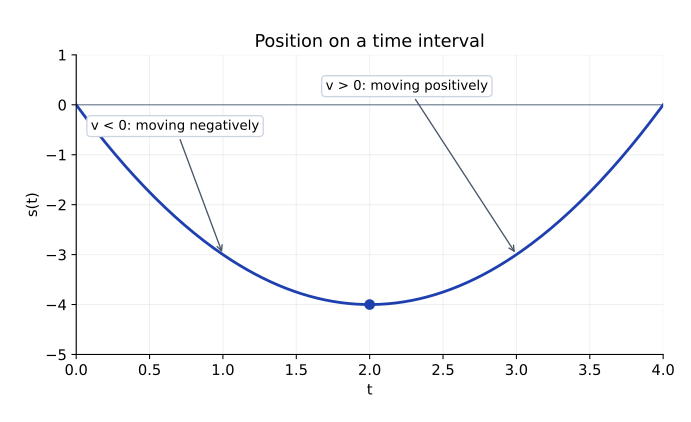
3. For s(t)=t2−4t\displaystyle s(t)=t^2-4t on [0,4]\displaystyle [0,4], describe direction and speed changes.
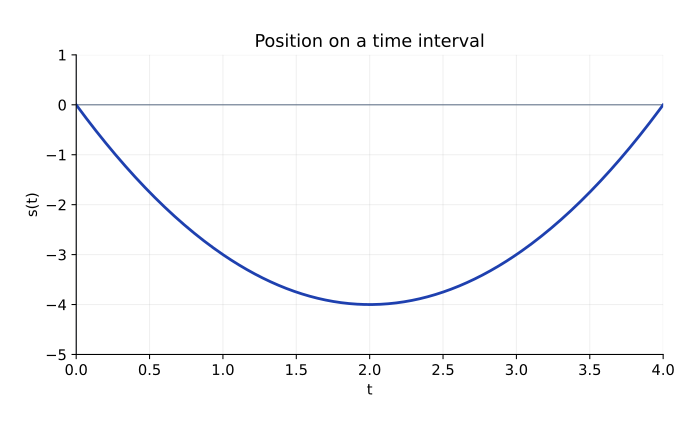
Position s(t) = t squared minus 4t is a parabola with a minimum at t = 2.
Use the position slopes to determine direction.
Show worked solution

Velocity is 2t−4\displaystyle 2t-4 and acceleration is 2\displaystyle 2. On (0,2)\displaystyle (0,2) the object moves negatively and slows down; on (2,4)\displaystyle (2,4) it moves positively and speeds up. It is at rest at t=2\displaystyle t=2.

Position s(t) = t squared minus 4t is a parabola with a minimum at t = 2. Negative slopes before t = 2 become positive after; acceleration is positive throughout.
Negative slopes before t = 2 become positive after; acceleration is positive throughout.

Need help with this topic?

Work through questions with a tutor and get help with the steps you find difficult.

Get help with this topic