Calculus Honors · AP-aligned study guide

3.3 · Derivative graphs, concavity, and curve analysis

Read a function’s behavior from first- and second-derivative evidence rather than from the height of a derivative graph.

AP 5.3–5.9 · Reading: Larson & Edwards §§3.3–3.4, 3.6

Learning objectives

  • Justify increasing, decreasing, and concavity intervals.
  • Identify extrema and inflection points from sign changes.
  • Distinguish a graph of f from graphs of its derivatives.

The sign of the first derivative controls direction

Where f′>0\displaystyle f'>0, the function increases; where f′<0\displaystyle f'<0, it decreases. The vertical height of a derivative graph records slope, not the value of f\displaystyle f. A derivative can be negative while increasing toward zero.

For f′(x)=x2−1\displaystyle f'(x)=x^2-1, signs are positive outside [−1,1]\displaystyle [-1,1] and negative between. Thus f\displaystyle f has a local maximum at −1\displaystyle -1 and a local minimum at 1\displaystyle 1.

The second derivative controls changing slopes

Where f′′>0\displaystyle f''>0, slopes increase and the graph is concave up. Where f′′<0\displaystyle f''<0, slopes decrease and the graph is concave down. An inflection point requires continuity and a change in concavity.

Solving f′′=0\displaystyle f''=0 gives candidates, not automatic inflection points. For x4\displaystyle x^4, the second derivative is zero at 0\displaystyle 0 but stays positive on both sides, so concavity does not change.

Use the second derivative test with its conditions

At a critical point with f′(c)=0\displaystyle f'(c)=0, a positive second derivative gives a local minimum and a negative second derivative gives a local maximum. If f′′(c)=0\displaystyle f''(c)=0, this test is inconclusive; use sign analysis.

To sketch a curve, combine domain, intercepts, asymptotes, direction, and concavity. Evaluate f\displaystyle f to locate extrema as coordinate points, and keep any domain exclusions visible.

f′(c)=0, f′′(c)>0 ⇒ local minimumf'(c)=0,\ f''(c)>0\ \Rightarrow\ \mathrm{local\ minimum}

Worked examples

Read a derivative

If f′(x)=x2−4\displaystyle f'(x)=x^2-4, locate local extrema.

  1. The critical inputs are −2\displaystyle -2 and 2\displaystyle 2.
  2. The derivative changes from positive to negative at −2\displaystyle -2, giving a local maximum.
  3. It changes from negative to positive at 2\displaystyle 2, giving a local minimum.

Concavity from a formula

Find the inflection point of f(x)=x3−3x\displaystyle f(x)=x^3-3x.

  1. The second derivative is 6x\displaystyle 6x.
  2. It changes from negative to positive at 0\displaystyle 0.
  3. The function is continuous and f(0)=0\displaystyle f(0)=0, so the inflection point is (0,0)\displaystyle (0,0).

Common mistakes

  • Reading a positive derivative as a positive function value.
  • Confusing decreasing slope with decreasing function.
  • Declaring an inflection point solely because the second derivative is zero.

Try it yourself

No calculator required.

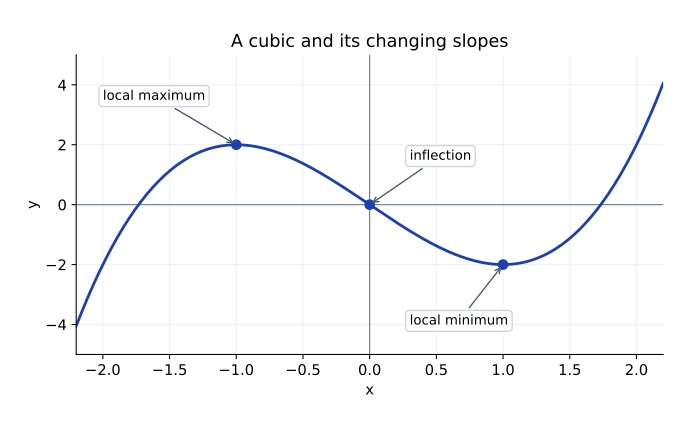
1. Analyze direction and concavity for f(x)=x3−3x\displaystyle f(x)=x^3-3x. Locate local extrema and the inflection point.
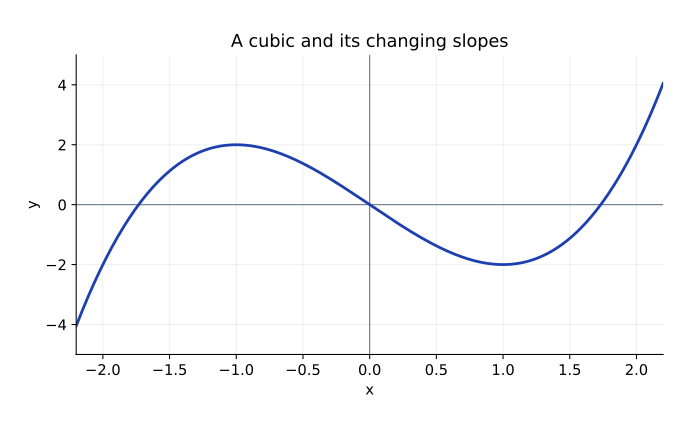
The graph y = x cubed minus 3x turns at x = minus 1 and x = 1.
Use derivatives to justify the turns and concavity.
Show worked solution

The first derivative is 3(x2−1)\displaystyle 3(x^2-1): increase on (−∞,−1)\displaystyle (-\infty,-1) and (1,∞)\displaystyle (1,\infty), decrease on (−1,1)\displaystyle (-1,1). Local maximum is (−1,2)\displaystyle (-1,2) and local minimum is (1,−2)\displaystyle (1,-2). The second derivative is 6x\displaystyle 6x, so the graph is concave down for x<0\displaystyle x<0, up for x>0\displaystyle x>0, with inflection at (0,0)\displaystyle (0,0).

The graph y = x cubed minus 3x turns at x = minus 1 and x = 1. Local maximum is (minus 1, 2), local minimum is (1, minus 2), with inflection at the origin.
Local maximum is (minus 1, 2), local minimum is (1, minus 2), with inflection at the origin.

2. If f′\displaystyle f' is positive and decreasing on an interval, describe f\displaystyle f.

Show worked solution

The function increases because its derivative is positive. Its slopes decrease, so it is concave down where this derivative behavior holds.

3. Does f′′(0)=0\displaystyle f''(0)=0 prove an inflection point? Use f(x)=x4\displaystyle f(x)=x^4.

Show worked solution

No. Here f′′(x)=12x2\displaystyle f''(x)=12x^2 is positive on either side of 0\displaystyle 0. Concavity does not change, so 0\displaystyle 0 is not an inflection input.

Need help with this topic?

Work through questions with a tutor and get help with the steps you find difficult.

Get help with this topic