Calculus Honors · AP-aligned study guide

3.4 · Optimization: constraints, domains, and justification

Turn a geometric or contextual goal into a one-variable function, then prove the candidate gives the requested optimum.

AP 5.10–5.11 · Reading: Larson & Edwards §3.7

Learning objectives

  • Build an objective function using a constraint.
  • Restrict the domain to physically meaningful values.
  • Justify a global optimum rather than reporting a critical number.

Separate the objective from the constraint

The objective is the quantity to maximize or minimize, such as area or cost. The constraint connects the variables. For a rectangle with perimeter 20\displaystyle 20, 2x+2y=20\displaystyle 2x+2y=20 lets you write y=10−x\displaystyle y=10-x.

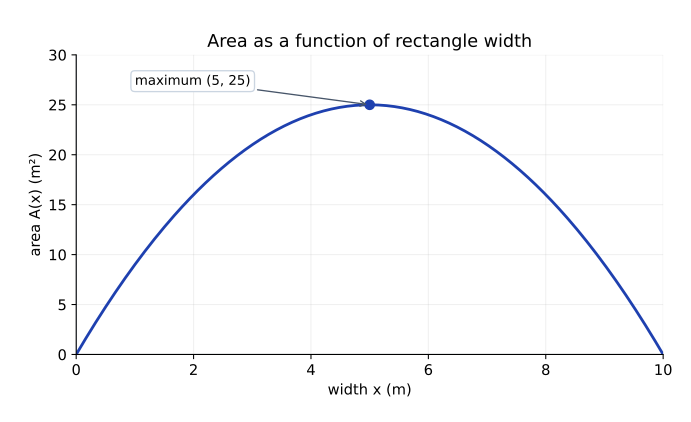
The area becomes A(x)=x(10−x)\displaystyle A(x)=x(10-x), with meaningful dimensions 0<x<10\displaystyle 0<x<10. A sketch and a domain prevent a mathematically valid but physically impossible solution.

Differentiate the objective and test the candidate

The derivative A′(x)=10−2x\displaystyle A'(x)=10-2x vanishes at x=5\displaystyle x=5. Its sign changes from positive to negative there, proving a maximum. The dimensions are 5\displaystyle 5 by 5\displaystyle 5, with area 25\displaystyle 25.

On a closed domain, compare endpoints too. On an open domain, justify with monotonicity or boundary behavior. Include units and translate the optimizing input back into the quantity requested.

A minimum can come from competing terms

For C(x)=x+9/x\displaystyle C(x)=x+9/x with x>0\displaystyle x>0, increasing x\displaystyle x raises the first term but lowers the second. The derivative 1−9/x2\displaystyle 1-9/x^2 balances these effects at x=3\displaystyle x=3.

The derivative is negative for 0<x<3\displaystyle 0<x<3 and positive for x>3\displaystyle x>3, proving an absolute minimum there. Merely solving C′=0\displaystyle C'=0 would not establish which kind of point it is.

Worked examples

Fixed perimeter

Maximize rectangle area with perimeter 24\displaystyle 24.

  1. Write y=12−x\displaystyle y=12-x, so A(x)=12x−x2\displaystyle A(x)=12x-x^2 for 0<x<12\displaystyle 0<x<12.
  2. Solve A′(x)=12−2x=0\displaystyle A'(x)=12-2x=0 to get x=6\displaystyle x=6.
  3. The derivative changes from positive to negative; the optimal dimensions are 6\displaystyle 6 by 6\displaystyle 6, with area 36\displaystyle 36.

Minimum cost

Minimize C(x)=x+16/x\displaystyle C(x)=x+16/x for x>0\displaystyle x>0.

  1. The derivative is 1−16/x2\displaystyle 1-16/x^2.
  2. The only positive critical input is 4\displaystyle 4.
  3. The derivative changes from negative to positive, so the minimum is C(4)=8\displaystyle C(4)=8.

Common mistakes

  • Differentiating before using the constraint to eliminate a variable.
  • Ignoring the physical domain.
  • Reporting a critical input without proving it gives the requested optimum.

Try it yourself

No calculator required.

1. A rectangle has perimeter 20\displaystyle 20 m. Find the maximum area and justify it.
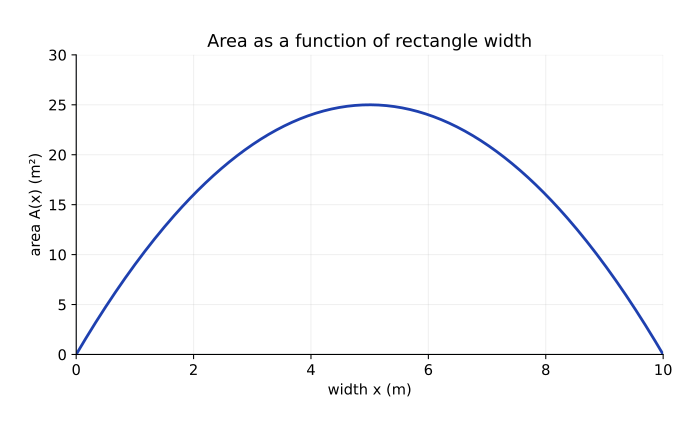
The downward parabola A(x) = 10x minus x squared is defined for widths between 0 and 10.
Use the derivative to locate the maximum area.
Show worked solution

The area is A(x)=10x−x2\displaystyle A(x)=10x-x^2 for 0<x<10\displaystyle 0<x<10. Its derivative changes from positive to negative at x=5\displaystyle x=5, so the maximum is 25\displaystyle 25 square meters for dimensions 5\displaystyle 5 by 5\displaystyle 5.

The downward parabola A(x) = 10x minus x squared is defined for widths between 0 and 10. The area is maximal at width 5, giving area 25.
The area is maximal at width 5, giving area 25.

2. Minimize C(x)=x+9/x\displaystyle C(x)=x+9/x on x>0\displaystyle x>0.

Show worked solution

The derivative is 1−9/x2\displaystyle 1-9/x^2, negative below 3\displaystyle 3 and positive above 3\displaystyle 3. Thus the absolute minimum occurs at x=3\displaystyle x=3 and is C(3)=6\displaystyle C(3)=6.

3. Find the point on y=x2\displaystyle y=x^2 closest to (0,1/2)\displaystyle (0,1/2).

Show worked solution

Minimize squared distance D(x)=x2+(x2−1/2)2=x4+1/4\displaystyle D(x)=x^2+(x^2-1/2)^2=x^4+1/4. This is minimized at x=0\displaystyle x=0, so the point is (0,0)\displaystyle (0,0) and the distance is 1/2\displaystyle 1/2. Squared distance has the same minimizer as distance.

Need help with this topic?

Work through questions with a tutor and get help with the steps you find difficult.

Get help with this topic