
An origin-centered ellipse
Analyze .
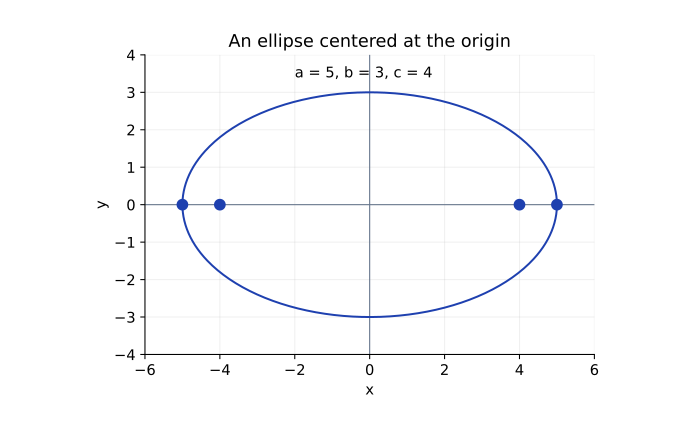
- The major axis is horizontal with and .
- The focal distance is .
- Vertices are and foci are .
Precalculus Honors · Study guide
Identify major-axis direction, derive focal distance from semiaxes, and interpret all features relative to the center.
Precalculus Honors · Reading: Demana 10th ed. §8.2; Stewart 8th ed. §§10.2, 10.4
For a horizontal ellipse, with . The center is and the major axis is horizontal. If the larger denominator is under the y-term, the major axis is vertical.
The major-axis length is , not or . Vertices and covertices are displaced from the center by the corresponding semiaxis lengths.
The focal distance satisfies . For a horizontal ellipse the foci are ; for a vertical ellipse they are .
The sum of the distances to the two foci is . Eccentricity is , between zero and one for a noncircular ellipse. Do not use the hyperbola’s plus relationship.
For , the center is , , , and . Every feature is measured from this center.
An equation with both squared terms positive can describe a real ellipse, a point, or no real locus depending on the constant after completing squares. Normalize to a positive right side before classifying.
Analyze .
Find the center and major vertices of .
No calculator required.
1. Find the vertices, covertices, and foci of .
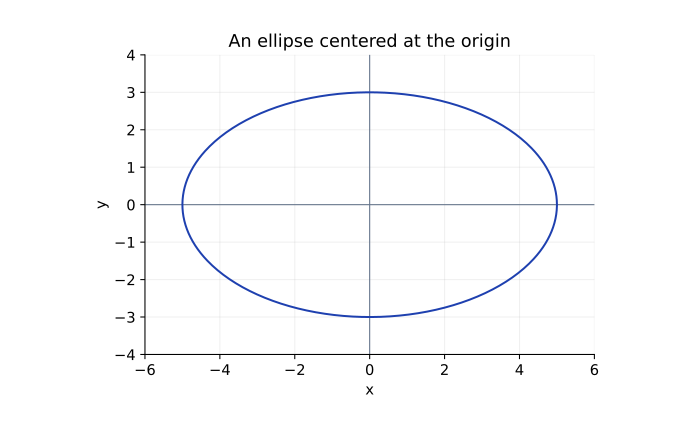
The vertices are , covertices , and foci because .
2. Find the center and major-axis length of .
The center is and the major semiaxis is , so the major-axis length is .
3. An origin-centered ellipse has horizontal vertices and foci . Write its equation.
Here , , so . The equation is .
Work through questions with a tutor and get help with the steps you find difficult.
Get help with this topic