Precalculus Honors · Study guide

5.3 · Hyperbolas: branches, foci, and asymptotes

Read the positive term to find opening direction, construct the asymptotes through the center, and locate foci beyond the vertices.

Precalculus Honors · Reading: Demana 10th ed. §8.3; Stewart 8th ed. §§10.3–10.4

Learning objectives

  • Identify hyperbola orientation and vertices.
  • Find focal distance using the sum of squared parameters.
  • Write asymptotes with correct slopes and shifts.

The positive squared term locates the transverse axis

The equation (x−h)2/a2−(y−k)2/b2=1\displaystyle (x-h)^2/a^2-(y-k)^2/b^2=1 opens left and right. Reversing the positive and negative terms to make y positive gives an up-down hyperbola.

For a horizontal hyperbola, the vertices are (h±a,k)\displaystyle (h\pm a,k). The larger denominator does not determine orientation; the positive term does.

Foci lie beyond the vertices

The focal distance is c=a2+b2\displaystyle c=\sqrt{a^2+b^2}, so c>a\displaystyle c>a. For a horizontal hyperbola, the foci are (h±c,k)\displaystyle (h\pm c,k). The absolute difference of distances to the foci is 2a\displaystyle 2a.

The plus relationship distinguishes a hyperbola from an ellipse. Inspect the equation’s signs before choosing a focal formula.

Asymptotes pass through the center

For a horizontal hyperbola, the asymptotes are y−k=±(b/a)(x−h)\displaystyle y-k=\pm(b/a)(x-h). For a vertical hyperbola they are y−k=±(a/b)(x−h)\displaystyle y-k=\pm(a/b)(x-h). A guiding rectangle provides a geometric check on the slope.

A complete sketch shows two branches approaching those lines, the correct vertices, and the center. Treat the asymptotes as limiting directions rather than pieces of the hyperbola.

Worked examples

An origin-centered hyperbola

Analyze x2/9−y2/16=1\displaystyle x^2/9-y^2/16=1.

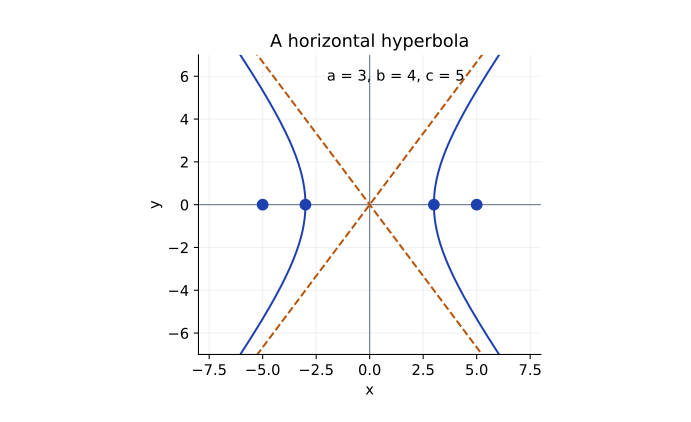
  1. The branches open left and right with a=3\displaystyle a=3, b=4\displaystyle b=4.
  2. The focal distance is 5\displaystyle 5.
  3. Vertices are (±3,0)\displaystyle (\pm3,0), foci (±5,0)\displaystyle (\pm5,0), and asymptotes y=±(4/3)x\displaystyle y=\pm(4/3)x.

A vertical hyperbola

Give vertices of y2/4−x2/9=1\displaystyle y^2/4-x^2/9=1.

  1. The positive y-term makes the transverse axis vertical.
  2. The value of a\displaystyle a is 2\displaystyle 2.
  3. The vertices are (0,±2)\displaystyle (0,\pm2).

Common mistakes

  • Choosing orientation from the larger denominator instead of the positive term.
  • Using c squared equals a squared minus b squared.
  • Forgetting to shift asymptotes through the center.

Try it yourself

No calculator required.

1. Find vertices, foci, and asymptotes of x2/9−y2/16=1\displaystyle x^2/9-y^2/16=1.

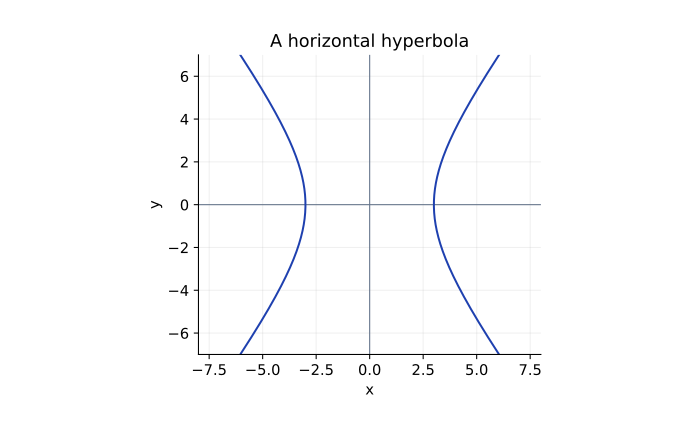
The curve x squared over 9 minus y squared over 16 equals 1 has two horizontal branches.
Use the positive term to locate the transverse axis.
Show worked solution

The vertices are (±3,0)\displaystyle (\pm3,0), foci (±5,0)\displaystyle (\pm5,0), and asymptotes y=±(4/3)x\displaystyle y=\pm(4/3)x. The branches open horizontally.

The curve x squared over 9 minus y squared over 16 equals 1 has two horizontal branches. Vertices are (plus or minus 3, 0), foci (plus or minus 5, 0), and asymptote slopes are plus or minus 4/3.
Vertices are (plus or minus 3, 0), foci (plus or minus 5, 0), and asymptote slopes are plus or minus 4/3.

2. For y2/4−x2/9=1\displaystyle y^2/4-x^2/9=1, give the opening direction and asymptotes.

Show worked solution

It opens vertically. The asymptotes are y=±(2/3)x\displaystyle y=\pm(2/3)x.

3. Find the center and vertices of (x−1)2/4−(y+2)2/9=1\displaystyle (x-1)^2/4-(y+2)^2/9=1.

Show worked solution

The center is (1,−2)\displaystyle (1,-2) and the horizontal semiaxis is 2\displaystyle 2. The vertices are (−1,−2)\displaystyle (-1,-2) and (3,−2)\displaystyle (3,-2).

Need help with this topic?

Work through questions with a tutor and get help with the steps you find difficult.

Get help with this topic